Get Full Government Meeting Transcripts, Videos, & Alerts Forever!
Get email alerts on the Planned Unit Development topic
No spam. Unsubscribe anytime.
Lewiston Planning Board reviews draft PUD ordinance, asks staff for legal check and clearer standards
Summary
The Lewiston Planning Board reviewed a first rough draft of a planned unit development ordinance that would grant flexibility and density bonuses to residential, commercial and industrial projects; members pressed staff to do a legal/compliance review and to clarify organizing principles, review criteria and how bonuses are earned. Staff said it will return a second draft after legal review and input from the housing committee.
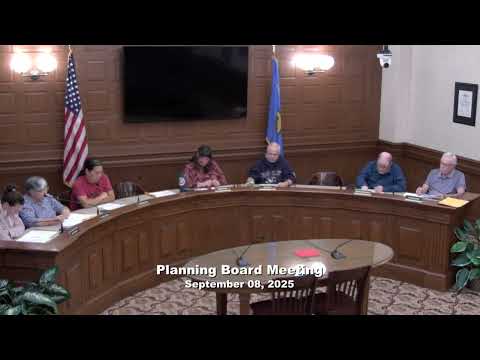
Shana Cox, chair of the Lewiston Planning Board, opened the meeting and said the board would focus on a first rough draft of a planned unit development (PUD) ordinance intended to give developers flexibility in exchange for community benefits.
Shelley Norton, deputy director and a member of city staff, told the board that the draft pulls together work begun Sept. 5, 2024 and discussed at multiple sessions in 2025 and that "what's before you tonight is a first rough draft of an ordinance we think hits on the concerns raised by yourselves as well as staff," but cautioned that "there are still elements that will need work" and that some flexibilities in the draft "may not comply with state law" and could conflict with variance requirements. Norton said staff plans to obtain legal and compliance review before returning a second draft.
Why it matters: the PUD ordinance would let applicants propose mixed-use or single-use developments that could receive density bonuses, height adjustments or relief from certain dimensional standards in exchange for outcomes the city prioritizes (for example, open space, ownership opportunities, or reduced infrastructure demand). Board members said the draft needs clearer organizing principles, review criteria and predictable rules so applicants and neighbors know how benefits are earned and how impacts will be mitigated.
Board discussion focused on three topics. First, terminology and purpose: members objected to repeated uses of the word "theme" and asked staff to use a consistent term ("organizing principle" or "purpose") and to make the introductory language plainly state whether an applicant must meet "one or more of the following goals." Several members said applicants should explicitly identify which organizing principle(s) they are pursuing and explain how their design advances them.
Second, measurable expectations and flexibility: the board debated whether to require percentage-based mixes for mixed-use PUDs (for example, a 20–80% range per use) or to ask applicants to provide square-foot breakdowns and a justification. Several members warned that rigid percentage rules are hard to apply in practice; staff and some members favored square-foot or unit-based reporting in the application. For dimensional flexibility, staff suggested a predictable cap (examples from other towns were cited, including a 25% figure) and recommended placing zone-specific flexibility allowances in a separate bulk-standards table or appendix.
Third, bonuses, affordability and state law: staff described a tiered bonus structure in the draft (a sample 30% housing bonus for certain strategies and a 60% bonus for other cases) and noted that state law (LD 2003) already requires a 250% density bonus for qualifying affordable housing projects that meet the state's standards. Board members asked staff to define "affordable" and "workforce" housing consistently with other city programs and to show how local bonuses relate to the state's LD 2003 incentives.
On ownership and resale controls, the board reviewed written feedback from absent member Amy Smith (read into the record). Smith argued a 10-year affordability resale restriction is too long and recommended a 3–5 year limit or a graduated sharing model so owners can capture some appreciation while preserving long-term affordability. Members generally favored a shorter period or a graduated approach so starter homes remain a path to upward mobility.
Procedure and applicant expectations were a recurring concern. Staff described a multi-step process: an optional pre-application conference for novel proposals, a concept review at which applicants would state their organizing principle(s) and requested modifications/bonuses (concept approvals were proposed to expire after a fixed period, staff suggested one year), and a final development review for detailed approvals and public hearings. The board debated whether concept review should be low‑stakes workshop-style or open to public input; several members recommended a low-barrier pre-application conversation but said the public should have opportunity to comment once an application reaches a concept or development stage with sufficient detail.
No substantial policy vote was taken on the ordinance; the board did take a formal, separate procedural vote to adopt the August 11, 2025 draft meeting minutes unanimously (moved by Alexander Pine, seconded by Penthia Burns). Norton said staff will bring a second draft after legal review and after soliciting feedback from the housing committee and other stakeholders.
What happens next: staff will seek legal/compliance review, tidy terminology (replace "theme" with a consistent term such as "organizing principle"), and return a second draft with clearer review criteria, a bulk-standards chart or appendix, and defined definitions for "affordable" and "workforce" housing. The housing committee is scheduled to review the draft and provide comments before the board’s next review.