Get Full Government Meeting Transcripts, Videos, & Alerts Forever!
Get email alerts on the Tcep Guidelines Overview topic
No spam. Unsubscribe anytime.
Commission staff preview draft TCEP guidelines, timeline and $800 million funding for cycle 5
Summary
Transportation Commission staff reviewed final proposed edits to the Trade Corridor Enhancement Program guidelines, saying the draft will be posted by June 12 and noting about $800 million will be available across two fiscal years; the changes incorporate CAPTI 2 strategies, clarify screening and allocation processes, and expand equity and workforce criteria.
Beverly Newman Burkhard, manager of the Trade Corridor Enhancement Program at the Transportation Commission, opened the final TCEP workshop and outlined the draft-guideline timeline and major changes staff will present to the commission.
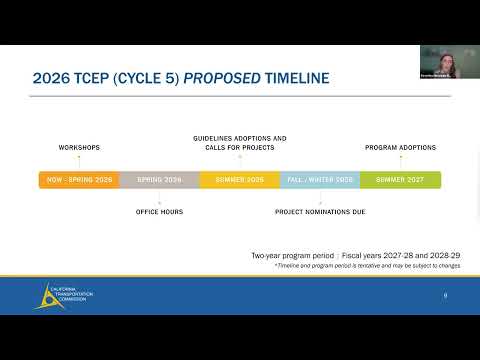
At the workshop, Burkhard said the commission expects to post the full draft guidelines by June 12 and to present them at the June commission meeting, with final adoption slated for the August meeting. "We generally get about $400,000,000 per year for the program," she said, noting the current cycle covers two fiscal years and therefore roughly $800,000,000 will be available in funding.
Why it matters: the revised guidelines set the rules that will determine which freight and zero-emission projects receive SB‑1 and federal freight funds. Changes staff flagged include integration of CAPTI 2 climate strategies, consolidated screening criteria, clarified allocation and advanced‑allocation rules, and expanded guidance on equity, community engagement and workforce development.
Staff described the CAPTI (Climate Action Plan for Transportation Infrastructure) updates adopted in March 2025 and said the TCEP language now directs applicants to describe passenger‑vehicle VMT mitigation measures when relevant; projects that mitigate passenger VMT will be more competitive under evaluation criteria. Ken (Kenneth Lopez) summarized program eligibility and funding structure, including the statutory split that directs approximately 40% of TCEP funds to Caltrans‑nominated projects and 60% to local or regional nominees.
The draft will also relocate several ZEV (zero‑emission vehicle) requirements into a more prominent eligible‑projects section to make ZEV project rules easier to find, and staff said they will add an appendix with ZEV project examples, metrics and resources to help applicants prepare narratives and performance measures.
Staff proposed edits to the screening criteria to consolidate requirements in one place: completed nomination, eligible applicant, primary program purpose (freight projects on high‑volume corridors), required funding match (30% for non‑Caltrans nominations), inclusion in an adopted regional transportation plan (and SCS where applicable), and environmental clearance timing (clear by program adoption or within six months). The guidelines will explicitly state that applicants must demonstrate local permitting approvals within six months if pursuing streamlined permitting under Assembly Bill 1236 or Assembly Bill 970.
On allocation policy, staff reiterated existing commission practices: the commission must approve future consideration for environmentally cleared projects before programming, allocations may be delayed into the next fiscal year without requiring an extension if funds are insufficient, and implementing agencies should not award construction contracts until the commission has approved an allocation. Staff said agencies may request advanced allocations if allocation capacity exists, but approval is not guaranteed.
Staff encouraged applicants to use office hours (running through May) for technical, one‑on‑one support with nominations and said presentations and recordings will be posted after the workshop. Burkhard closed by inviting written comments and questions through the public comment period before the draft posts.
The draft guidelines are scheduled to be presented at the June commission meeting and returned for adoption at the August meeting; staff said they will post the draft by June 12 and invited stakeholders to review materials and provide feedback before final adoption.