Get Full Government Meeting Transcripts, Videos, & Alerts Forever!
Get email alerts on the Demolition topic
No spam. Unsubscribe anytime.
Commission votes to allow demolition of two deteriorated houses on Gaines Street amid neighborhood concern
Summary
After extended discussion about public‑safety complaints, code enforcement history and program funding, the commission voted to permit demolition of 520 and 522 Gaines St., concluding the structures do not meet local landmark criteria; commissioners and residents expressed regret and concern about resources and next steps for compatible infill.
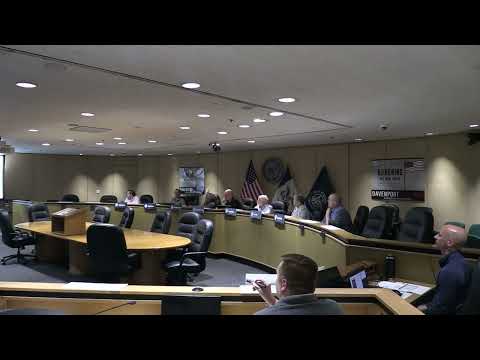
The Davenport Historic Preservation Commission voted May 12 to allow demolition of two long‑deteriorated contributing structures at 520 and 522 Gaines Street under separate cases (DNDNRHDNRHP26‑01 and DNRHP20602), after staff summarized decades of code enforcement, vacancy indicators and repeated public‑safety calls.
Staff told the commission both houses are listed as contributing structures in the Hamburg National Historic District but are not locally listed. Staff reported a history of code enforcement actions: certificates of substandard building and final notices to repair or demolish issued in 2022, low assessed values (about $26,380 for 520 and $16,650 for 522), limited recent permits and no sanitary sewer billing since at least 2010 — an indicator that the houses have likely been vacant for years. Staff also cited 34 and 43 police response calls since 2010 for the two properties respectively and said one property was so deteriorated staff could not safely enter.
Staff recommended demolition and explained the city has a purchase agreement under the Extreme Dream revitalization effort to acquire the lots and remove the structures as part of a neighborhood revitalization strategy, with potential to construct a single‑family home over the combined footprint and possibly add another home later.
Commissioners and members of the public voiced two competing themes. Some speakers described immediate safety and nuisance problems — leaning foundation walls, homeless encampments, trespass and suspected drug activity — and said the houses present hazards that justify demolition. Others, including a commissioner who described themselves as "ashamed of the city," urged more proactive preservation and argued worker‑class housing from the late 19th century still has value in the urban fabric; that speaker said the houses “continue to convey their historic form, massing and residential character.”
City economic‑development staff (Suzanne Knutson) explained the city’s process: owners approached the city to convey the buildings under a purchase agreement, and the city evaluates projects against limited funding and neighborhood priorities through the Extreme Dream program. Knutson said the city can forgive some lien costs tied to maintenance actions but cannot forgive property taxes or sewer liens; she noted the city must prioritize the worst properties when funds are limited.
Commissioners also discussed oversight of future construction on the cleared lots. Staff clarified that because the properties are in a National Historic District and are not locally listed, new construction would not return to the preservation commission for design review; however, zoning design guidelines require compatibility in massing, porches, windows and materials and could be used to guide compatible infill. Several commissioners expressed concern about ensuring neighborhood input and avoiding past city projects that have not aged well.
The commission made motions to approve demolition of 520 Gaines and of 522 Gaines separately; roll‑call votes recorded affirmative votes and the motions carried. Several commissioners and attendees closed the discussion with calls for better proactive preservation strategies, noting the city faces limited budgetary capacity to save marginal historic properties before they deteriorate beyond repair.
Next steps: the city will proceed with demolition under the approved actions and the Economic Development/Neighborhood Services departments will coordinate any subsequent site planning and compliance with zoning/design guidelines for replacement housing.