Get Full Government Meeting Transcripts, Videos, & Alerts Forever!
Get email alerts on the Licensing Roundup topic
No spam. Unsubscribe anytime.
Community Board reviews a slate of restaurants; applicants agree to hours, occupancy and sound‑mitigation conditions
Summary
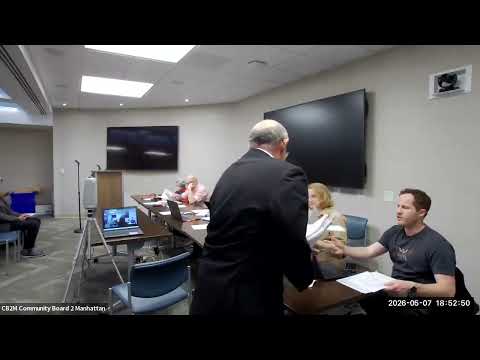
Community Board 2's licensing committee reviewed multiple restaurant and tavern license and method‑of‑operation applications, including Port Said, El Camaron, Pottery Manhattan, Peoples and others. Applicants frequently agreed to limits on outdoor seating, closing hours, private parties and to soundproofing or door‑closure stipulations requested by neighbors.
The Community Board 2 CPQ SLA committee reviewed a slate of new and altered liquor‑license applications spanning Hudson Street, Cornelia Street, West 13th and surrounding blocks. Several applicants agreed to community‑requested stipulations on closing hours, private parties and sound mitigation.
Michael Kelly, representing Port Said at 350 Hudson Street, described the Mediterranean restaurant's layout and hours and told the committee the venue will not have outdoor seating and will close doors by 9 p.m. when requested. Kelly said the restaurant has a packed interior layout but will comply with occupancy and door stipulations the committee requested.
On Cornelia Street, owner Tanya said El Camaron will operate as a small seafood concept under the tavern class because of the site’s limited footprint, but that it will be “food‑focused” with a full menu and beer and wine only. Tanya and her representative agreed to keep bathroom windows closed and not to use the rear yard for staff breaks.
Several other applicants agreed to similar conditions: closed or inoperable front windows, background music only, no outdoor seating, and limits on private buyouts (typical commitments ranged from four to 24 per year depending on the venue). Committee members repeatedly pressed applicants to confirm whether basement square footage and certificate‑of‑occupancy figures matched the applicant filings; applicants were asked to obtain or update CO documents when necessary.
For venues seeking later hours (notably an extension request at Peoples, 113 West 13th Street), applicants presented letters of support from residents above the premises and said they had generally complied with prior board stipulations. The committee sought assurances about curbside congregating and Uber/drop‑off patterns; applicants said they would request guests to use a designated drop‑off point and would include the pin location in reservation confirmations.
In multiple cases the committee required or recommended follow‑up documentation: updated CO/fire‑department occupancy confirmation, written stipulations on door/window/operational hours, and proof of outreach to affected block associations. Where applicants said they were removing or decommissioning rooftop or exterior speakers they were asked to present documentation that the speakers were deactivated.
Several items on the evening’s agenda drew minimal public opposition and proceeded with committee directions to draft stipulations; others required more intensive follow‑up or possible referrals to agency enforcement (notably the site on West 10th Street covered in a separate article). The transcript excerpt supplied does not include final roll‑call vote tallies for every application; committee members indicated a mix of approvals with stipulations and items to return with required documentation.
The board also repeatedly reminded applicants that if a venue’s physical capacity or CO is inconsistent with an application they must update permits before the license is finalized.