Get Full Government Meeting Transcripts, Videos, & Alerts Forever!
Get email alerts on the Sidewalk Cafe Enforcement topic
No spam. Unsubscribe anytime.
Neighbors press Community Board over enclosed sidewalk cafe, sound and hours at proposed Cherry Club site
Summary
Community Board 2 heard sustained public opposition to a fine‑dining application at 141 West 10th Street after residents said an adjacent enclosed sidewalk café has been operated as a de‑facto sports bar with TVs, bolted structures and noise. Applicants offered soundproofing and door/hours stipulations; no final board vote is recorded in the provided transcript.
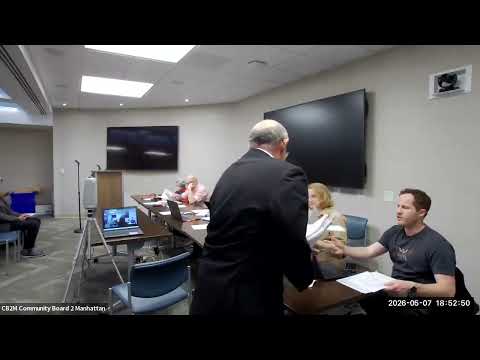
Donna Braktery, chair of Community Board 2’s CPQ SLA committee, heard more than an hour of public comment Tuesday about a fine‑dining application for 141 West 10th Street that centered not on the new restaurant itself but on an adjacent enclosed sidewalk café and outdoor dining structure.
Leslie Clark, who said she represents West Village residents, told the committee the enclosure is “bolted to the ground” and that attempts to get it removed have failed. “The sole holdout is Judy Ziggs, and it's bolted to the ground,” Clark said, arguing the structure remained after city efforts to remove illegal enclosed roadbeds.
Residents who live on streets that abut the site described repeated episodes of loud sidewalk dining, outdoor televisions and crowding that they said spill into the evening hours. David Gerber, president of the Carmine Street Block Association, called the operator “a classic bad actor restaurant,” saying the sidewalk structure routinely blocked sidewalks and drew large crowds.
The applicant team, represented by attorney Max Bookman and restaurateurs including Simon Kim, said the proposed Cherry Club is a reservation‑focused, fine‑dining steakhouse that will limit buyouts to four per year, keep doors closed at all times and operate without live music or DJs. Kim, who described his approach to restaurants as community‑oriented, told the board, “I always create restaurants where it’s welcoming to the community and food‑focused.”
Max Bookman asked the committee to weigh the proposed conditions against the risk that the space would remain vacant or be taken by a concept with fewer restrictions. “We are significantly reducing stipulated hours and occupancy compared with the past,” he said, adding that the concept is designed to be restaurant‑centric rather than nightlife‑oriented.
Many residents remained unconvinced. They urged earlier closing times—citing nearby standards set at midnight for comparable venues—as well as firmer enforcement of sidewalk‑cafe rules and confirmation from the Department of Transportation and the state liquor authority about the enclosure’s legal status. Multiple speakers asked the board to refer the matter to the State Liquor Authority or other city agencies for clarification of existing enforcement actions.
The transcript shows extensive questioning by committee members and offers from the applicant to soundproof interior spaces, board up or make operable windows inoperable, and to commit to closed doors and a hard closing hour for weekday nights. The provided excerpt does not include a clear roll‑call vote or a final, recorded disposition for the Cherry Club application. The committee announced a short break following public comment and continued deliberations, but a final decision is not recorded in the segments provided.