Get Full Government Meeting Transcripts, Videos, & Alerts Forever!
Get email alerts on the Budget topic
No spam. Unsubscribe anytime.
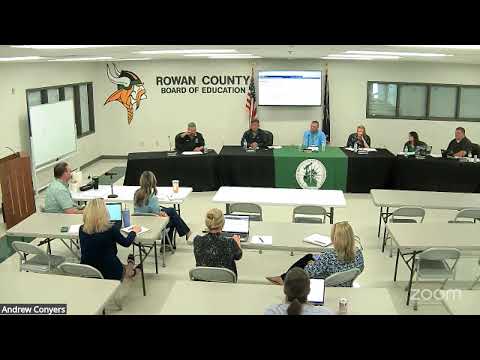
Rowan County board reviews tentative 2026–27 budget, proposes $850 supplement and hires to reduce special‑ed contracts
Summary
At a special May 12 work session, Rowan County Board of Education reviewed a tentative budget that proposes an $850 annual supplement for certificated staff, a 35¢ hourly increase for classified staff, new hires to replace contracted special‑education services and a revised summer feeding plan; the board will consider final approval at its next meeting.
Rowan County Board of Education members met in a special called work session on May 12 to review the tentative 2026–27 budget, which proposes a $850 annual supplement for certificated staff, a 35¢ hourly increase for classified employees and new in‑house hires intended to reduce contracted special‑education costs.
The budget presentation was led by a district staff member who described the packet of materials sent to board members and emphasized that this is a tentative budget to be tightened before the working budget in the fall. “We do an $850 a year for all salary people,” the staff member said, adding that the classified pay adjustments are intended to parallel the certificated supplement.
Why it matters: the tentative plan uses recent enrollment growth and a projected $350,000 increase in SEEK funding to increase carryover, cover personnel changes and avoid short‑term borrowing. The staff member said the district is not borrowing to meet payroll. “We are not borrowing money to make payroll. I promise,” the staff member said, framing the package as fiscally conservative while expanding services.
Key provisions and trade‑offs - Salary changes: The budget includes a proposed $850 per year supplement for certificated staff and a 35¢ hourly increase for classified employees; the district will present the pay package for board approval at the next meeting. - Special education: To reduce expensive contracted services, the tentative budget adds staffing for speech services and other special‑education roles. The staff member said four new speech positions would be added and contract payments from the general fund would be reduced by about $250,000. - Federal funding and billing: The district plans to use federal IDEA funds (about $800,000 annually, restricted for special‑education uses) and Medicaid billing (the staff member estimated roughly $500,000 annually tied to nursing and special‑ed services) as part of the funding strategy, noting the need to code payroll carefully so reimbursements are preserved. - Insurance: The district’s previous insurer dropped coverage; staff said an agent‑of‑record process produced a new carrier (discussed in the meeting as Obsidian) with an estimated ~10% premium increase but lower deductibles and broader coverage. - Transportation and staffing: The tentative budget includes additional funding for buses. Board members and staff also discussed nationwide driver shortages and recruitment strategies such as offering combined duties (for example, bus driving plus custodial or tech aide hours) and paying for CDL training. - Technology and facilities: The budget adds one technology aide to support district devices and reclaims one room from an underused Gateway childcare lease (reducing the contract and repurposing space for district childcare needs). - Summer feeding: The district will move to a weekly pickup model for summer meals—on Thursdays from 3 to 5 p.m.—where families can pick up seven breakfasts and seven lunches per eligible child; staff reported early pick‑up events served roughly 160 and then about 575 children, and said federal reimbursement covers most program costs. “We’re doing something completely different this year,” the staff member said of the new approach.
Board questions and fiscal controls Board members asked about sustainability if enrollment growth slows. The staff member said salaries and staffing represent roughly 80% of the budget and acknowledged contingency depends on enrollment trends; the district is targeting an operational carryover in the range they described as healthy (staff noted a goal around $3 million and contingency closer to 8–10% of the general fund to manage cash‑flow risks tied to tax revenue timing).
Next steps and procedural outcome Staff will present the tentative budget unchanged at the next regular meeting for board consideration and formal action. At the end of the work session a board member moved to adjourn and the chair seconded; the board completed a voice vote to adjourn the special session.
Authorities and funding programs discussed in the meeting were federal IDEA funding and Medicaid reimbursement rules; the staff member repeatedly emphasized that IDEA dollars are restricted and Medicaid billing rules affect how staff are paid and coded.
Speakers (as attributed in this report) are listed by role as used during the meeting: the Chair and a Staff member who presented the budget, plus several Board members who asked questions and contributed to discussion. The board will return at its next regular meeting with the tentative budget on the agenda for formal approval.