Get Full Government Meeting Transcripts, Videos, & Alerts Forever!
Get email alerts on the Mbhslrp Application topic
No spam. Unsubscribe anytime.
California launches Medi‑Cal behavioral health loan‑repayment application; $93.3 million available this cycle
Summary
Health Care Access and Information opened applications May 1 for the Medi‑Cal Behavioral Health Student Loan Repayment Program, with a May 29 3:00 p.m. deadline, up to $93.3 million in cycle funding and awards as large as $240,000 depending on profession and service obligation.
Health Care Access and Information said the Medi‑Cal Behavioral Health Student Loan Repayment Program (MBH SLRP) opened May 1 and will accept applications through May 29 at 3:00 p.m., with award notices anticipated in September and grant agreements starting in October. "The application opened on May 1, and the deadline to apply is May 29 at 03:00PM," Jessica McIntyre, the program manager overseeing MBH SLRP, told participants.
Samantha Sadler, behavioral health policy specialist at HCAI, said the cycle includes up to $93,300,000 in funding and that awards may reach $240,000 for certain professions. "We have up to $93,300,000 for this year's MBH SLRP cycle, and it has awards up to $240,000 in loan repayment depending on your profession," Sadler said. Award size is determined by profession and the applicant's eligible educational debt; grantees will not receive more than the remaining eligible loan balance at time of payment.
The program requires recipients to complete a service obligation in Medi‑Cal safety‑net settings. Service obligations vary by award: certain top‑tier professions (including psychiatrists, nurse practitioners and physician assistants) are eligible for up to $240,000 and have a four‑year obligation; a second tier (clinical social workers, licensed clinicians, registered nurses and similar roles) is eligible for up to $180,000 with a four‑year obligation; and other eligible roles (peer support specialists, community health workers, AOD counselors and comparable positions) are eligible for awards up to $120,000 with obligations that depend on award amount (two to four years).
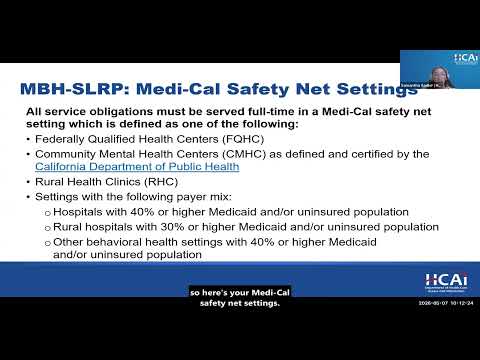
Eligible practice sites must meet HCAI's Medi‑Cal safety‑net definitions and payer‑mix thresholds (examples given by presenters included hospitals with 40% or higher Medicaid or uninsured populations and rural hospitals with at least 30% Medicaid or uninsured). Full‑time employment is defined as a minimum of 32 hours per week of direct client care (or 30 hours per week in school‑based settings); direct care includes face‑to‑face, telehealth and first‑line supervision.
Applications require an NPI (if applicable), evidence of license/credential, an unofficial transcript showing required education, loan statements for each education‑related loan, contact information for two personal references, and, where applicable, a conflict‑of‑interest letter for those who have worked or currently work for the state or California public higher‑education systems. Applicants must provide a point of contact for each employer; that contact will receive an employment verification form (EVF) by email and the application is incomplete until the EVF is completed. Awarded grantees must also submit an EVF every six months during their service obligation.
Payments are issued directly to recipients' loan servicers and are expected sometime between November 2026 and November 2027, McIntyre said. HCAI's breach policy requires recoupment of payments if a grantee fails to perform the service obligation, with waivers permitted only in very limited circumstances.
The grant guide lists eligible and ineligible loan types (for example, Parent PLUS loans, personal lines of credit and loans in default are ineligible). McIntyre said printable account summaries from servicers are typically acceptable when an official statement is not available. HCAI will give preference in scoring for factors including languages spoken, prior participation in public programs, prior safety‑net experience, service in HCAI‑identified shortage areas, and employment at Medi‑Cal specialty behavioral health sites.
For questions not addressed in the webinar, organizers directed applicants to mbhslrp@hcaI.ca.gov and the BH Connect helpline at (916) 326‑3899; the webinar recording and slide deck will be posted on HCAI's website. The application web page and grant guide are linked from the HCAI resources page.