Get Full Government Meeting Transcripts, Videos, & Alerts Forever!
Get email alerts on the Education Funding topic
No spam. Unsubscribe anytime.
Tomorrow River superintendent seeks $900,000 referendum to cover projected budget shortfall
Summary
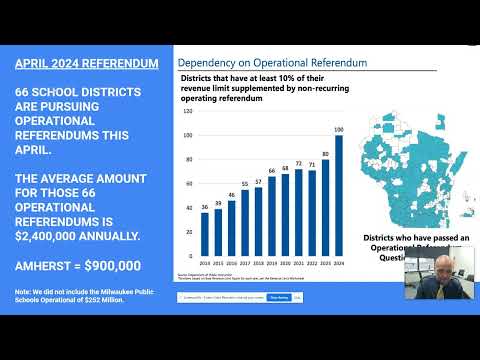
Superintendent Ryan Ruggles asked voters to approve a $900,000 nonrecurring operational referendum each year for three years to address projected deficits, saying the measure would fund planning and help avoid deeper cuts; he estimated a $213 annual tax increase on a $300,000 home.
Ryan Ruggles, superintendent of the Tomorrow River School District, asked district residents to approve a $900,000 nonrecurring operational referendum each year for three years to help cover projected budget shortfalls and support long-range planning.
Ruggles told families and stakeholders that the district—xpects its current $400,000 operational referendum to expire at the end of the year and that officials are looking at a projected $850,000 shortfall over the next two years. "What we are asking the community for is a $900,000 nonrecurring operating referendum for... the next three years," Ruggles said, adding the district will "start making those cuts already in year one and be ready for that" in later years.
The superintendent framed the request as a targeted and temporary measure to provide breathing room for planning, to advocate for changes to the state funding formula, and to rebuild community trust while exercising fiscal responsibility. "What this plan allows us to do is to continue doing some long-range planning, advocate for a change in the state funding formula and also build back on some community trust," he said.
Ruggles said the district's ask is lower than the statewide average for operational referendums and noted the district—elieves it has been efficient with resources: "we are the highest achieving district in the conference and we also are the lowest spending when we look at the educational cost per student within the conference." He said those facts support asking only what the district needs.
On local tax impact, Ruggles said, "for a $300,000 property you'd be looking at about $213 in increase on your taxes per year." He added that the mill rate is expected to decline in years two and three and directed listeners to a longer presentation for detailed calculations.
Ruggles closed by inviting questions, restating the district's commitment to teaching, learning and social-emotional supports, and urging residents to vote on April 2.
The referendum request and the district—stimates were presented by Ruggles during the address; the transcript contains the district's projections but does not include additional budget documents or an itemized spending plan in this audio.