Get Full Government Meeting Transcripts, Videos, & Alerts Forever!
Get email alerts on the School Schedule topic
No spam. Unsubscribe anytime.
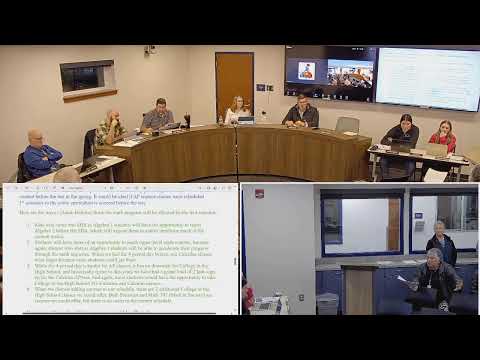
Sultan School District workshop weighs 4x4 semester schedule amid cost and program concerns
Summary
District staff, teachers and program instructors at a Sultan School District workshop debated the merits of moving Sultan High School to a 4x4 semester schedule. Instructors warned of costs and impacts to career-technical programs and intervention staffing; the board requested detailed cost estimates and set a decision target of late January.
At a district workshop, Sultan School District trustees, administrators and teachers spent more than an hour debating whether Sultan High School should switch from a seven-period day to a 4x4 semester schedule. No vote was taken; the board asked staff for detailed cost estimates and set a target to decide by the end of January.
District staff said the scheduling recommendation came from a year-long committee and bargaining discussions and was intended to reduce the seven-period day and expand elective and intervention opportunities. Serita, a district staff member who led the presentation, said the goal is to have a master schedule in place so students can register: "it is a school schedule—it's not an admin schedule, it's not a board, it's a school thing," Serita said, noting the board asked for a decision by the end of January to allow registration and planning.
Teachers and CTE instructors raised practical concerns. One teacher described the grading and planning load under shorter periods, saying that with 47-minute classes "it's not enough" time for many subjects and that the seven-period day increased daily student contacts and reduced teachers' ability to run after-school activities. Jill, a classroom teacher, cautioned about very long class periods: "kids cannot handle 90 minutes," she said, and added that yearlong performance and music programs would struggle if the schedule compressed required practice and events.
Career and technical education instructors said the 4x4 model would change how multi-term CTE sequences run and could increase material and staffing costs. An instructor who oversees the school greenhouse said the program produced about 2,000 plants last year at a CTE cost of roughly $1,300 and warned that some propagation cycles require seven months, making it difficult to compress certain hands-on sequences into single-term classes. Woods and culinary instructors also reported likely material- and staffing-cost increases of roughly 30–35% for programs that would run continuously without current interruptions.
AP and core-course sequencing came up as both a concern and a potential benefit. An AP teacher said concentrating AP classes in the first semester could allow teachers to finish AP curricula by February and provide students more time for review before May exams. Board members and teachers also discussed math sequencing: a semester model could let students reach Algebra II before state testing, but several participants stressed that the potential gains hinge on a well-designed intervention structure.
Several participants emphasized that a schedule change will succeed only if intervention time is planned, funded and staffed. Staff described a model of "priority" intervention days and cited an example district (White River) that dedicates additional counselor and coordinator time to manage interventions. "If intervention is not intentional, deliberate, planned, funded and staffed," a staff member said, "then whatever decision you make will not be successful." The district acknowledged it does not yet have a firm cost estimate for the staff or software systems that an intentional intervention program would require.
Administrators also noted outside factors that delayed the scheduling work: they had sought consultant support to build new schedules but said work slowed after a data breach at PowerSchool. Staff asked the board for time to develop detailed cost breakdowns, including the effect of pulling shared teachers back to the high school (which would increase FTE costs and affect the AL/SVO programs).
Board members and staff said they are reviewing student survey feedback; students’ top concerns were break length and how the schedule change would affect on-time graduation and course planning. The board agreed to request cost details and to hold an extra study session before the next business meeting to review the financial and staffing implications.
The workshop ended without formal action. The board reiterated the timeline aim of making a scheduling decision by the end of January after staff provide more detailed cost and staffing analyses.