Get Full Government Meeting Transcripts, Videos, & Alerts Forever!
Get email alerts on the Workers Compensation Offset topic
No spam. Unsubscribe anytime.
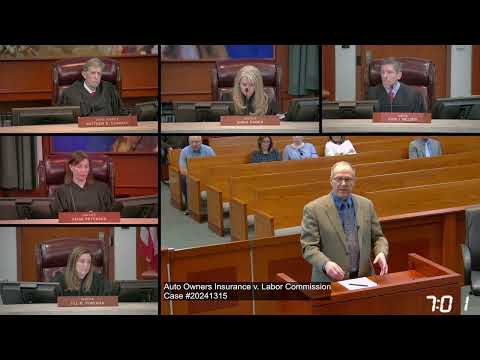
Utah Supreme Court examines how workers'compensation recoveries should account for attorney fees in Auto-Owners Insurance v. Labor Commission
Summary
The court heard competing readings of subsection 5 of a Utah statute that governs distribution of third-party recoveries when a workers' compensation claim exists: whether attorney fees must be removed before computing the carrier''s proportionate share and whether probable future, unpaid benefits may be included in that computation. The bench took the case under advisement.
The Utah Supreme Court on May 16 heard argument in Auto-Owners Insurance v. Labor Commission over how to compute a workers' compensation carrier's share of attorneys' fees and offsets when a third-party settlement exists.
Mark Sumption, counsel appearing for Auto-Owners and HB Construction, told the court the dispute turns on subsection 5 of section 34A-2-106 and on whether the statute requires using a "net" recovery (after attorney fees are taken off the top) to calculate the carrier's proportionate share. "Workers compensation is a dynamic process whereas personal injury is a static process," Sumption said, adding that the statute's mechanics should avoid converting the workers' compensation system into a personal-injury valuation scheme.
Sumption illustrated his view with a hypothetical $5 million third-party settlement and a $1 million paid-benefits "lean" (paid amounts). He argued that when attorney fees are deducted first, the offset available to the carrier is smaller and the carrier should not be charged for future, unpaid benefits that have not yet "accrued." He warned that including speculative future benefits to calculate proportionate shares will produce additional litigation over valuation and could result in unrecoverable overpayments.
A different view came from the attorney identified in the record as Miss Ain, who told the court the subsection operates as a disbursement statute that instructs third-party attorneys how to divide a recovered fund and that the proper first step is to compute parties' interests on the gross settlement. "Most people call it the subregation statute, but I prefer the dispersement statute," she said, arguing that subsections 5A, 5B and 5C work together: A allocates attorneys' fees proportionately, B reimburses the carrier for benefits paid less its share of fees, and C directs the balance to the injured worker subject to an offset of future benefits.
Under that reading, counsel argued, the court must first determine the carrier's combined interest (paid benefits plus the offset the carrier will be relieved of in the future) and divide by the gross settlement to compute the proportionate share; that percentage then governs how much of the attorney fees the carrier must pay. In the case at bar, the commission concluded that including probable future benefits made the carrier's statutory interest equal or exceed the settlement amount, producing an outcome that required the carrier to bear essentially all attorney fees.
Justices pressed both sides on practical consequences and terminology. One justice asked whether the employee is effectively "advancing" the carrier's share of attorney fees under a net-recovery reading; counsel disagreed about who bears risk if future benefits never vest. The bench also queried when fees are considered "paid" for purposes of the statute and noted that some jurisdictions use a gross-offset approach that contains mechanisms to reimburse the injured worker as funds are expended.
Both advocates acknowledged trade-offs. Sumption said the net-recovery reading better preserves the pay-as-you-go nature of workers' compensation and limits speculative valuation; Miss Ain replied that using gross amounts to determine proportional interests makes the statute operate consistently regardless of when a third-party settlement occurs and that expert evidence (life-care plans, economists, medical panels) can reduce uncertainty about probable future benefits.
The court did not rule after the arguments and took the case under advisement.
What it means: The justices will resolve a recurring tension in cases where catastrophic injuries create ongoing workers' compensation exposure but a separate third-party settlement is smaller than the present-value estimate of future benefits. The outcome could determine whether carriers are required to pay attorney fees proportionate to a combination of past paid benefits and probable future unpaid benefits, or whether attorney fees should be deducted before that proportion is computed.
The transcript shows disagreement over words and calculations used by counsel. The record contains variant spellings of some names (discussed below); the argument record itself will be the basis for the court's decision, which the court said it will issue after taking the matter under advisement.