Get Full Government Meeting Transcripts, Videos, & Alerts Forever!
Get email alerts on the School Closure topic
No spam. Unsubscribe anytime.
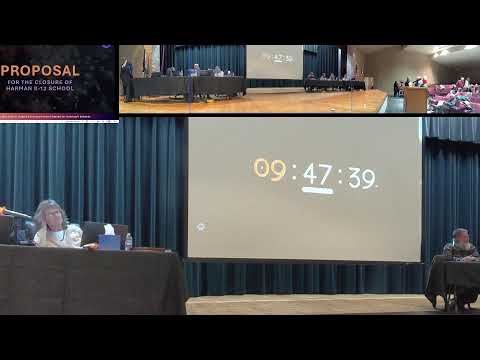
Randolph County board approves plan to close Haron K‑12 and merge students into Midland campuses
Summary
After a lengthy public hearing in which parents, teachers and residents urged alternatives, the Randolph County Board of Education approved the superintendent’s recommendation to close Haron K‑12 and transfer students to Midland Elementary, Midland Middle and Midland High, citing declining enrollment and budget shortfalls.
The Randolph County Board of Education voted to approve the superintendent’s recommendation to close Haron K‑12 and merge its students into Midland Elementary, Midland Middle and Midland High, district officials said following a public hearing and voice vote.
Superintendent (speaking as "Superintendent" in the record) framed the plan as a response to multi‑year enrollment declines and revenue shortfalls under the existing state funding formula, which he described as a "one‑size‑fits‑all" model that leaves sparsely populated counties fiscally constrained. The administration presented building‑utilization figures and projections it said show continued enrollment declines and limited options for maintaining all current facilities.
The administration told the board the draft impact document, using a three‑year averaging approach, projects about $1.38 million in net savings if Haron is closed and students are consolidated into the Midland campuses; administrators described that figure as an estimate that depends on final state funding determinations and enrollment. The superintendent also said personnel changes associated with the plan could affect roughly 31–32 positions across the district, and that some operating costs (child nutrition and some county‑level textbook costs) would follow the students rather than be eliminated.
The hearing drew prolonged public comment. A number of grandparents, parents and teachers urged the board to delay a vote and seek state assistance, grants or local revenue options instead of closing schools. One public commenter told the board, "Save our school, save our children," arguing the school is a community anchor and that long bus rides would harm young students. Another parent warned that some daily bus rides already run long and that consolidation could push some routes toward the 60–90‑minute range in worst‑case scenarios, a point transportation staff acknowledged while describing proposed route adjustments intended to limit added travel time.
Michelle Du, a local representative of the West Virginia Education Association (Rand County), said the union would support staff through any transition and urged the board to continue seeking alternatives, while several teachers said student achievement and the school’s supportive environment might be harmed by closure.
Board members questioned administrators about the impact‑document assumptions. District staff said the $1.38 million projection is a net estimate based on three‑year averages, that utilities savings would be modest, and that some personnel costs would shift rather than disappear. The administration noted that certain statutory and timetable constraints limit options before the next budget cycle and that the state Department of Education could play a role if academic performance does not improve at identified schools.
Following the public comment period, the board held a voice vote on the superintendent’s recommendation. The chair asked those in favor to signify by saying "I," and the motion was declared passed by voice; the transcript does not record a roll‑call tally. The board announced it will conduct deliberations in a subsequent meeting and that no additional decision on implementation details was made at the hearing.
What happens next: the board scheduled further deliberations and indicated implementation details — including any personnel preference voting, staffing assignments and finalized bus routing — will be addressed in follow‑up sessions. The administration emphasized several figures presented in the hearing were preliminary and subject to change pending final state funding numbers and enrollment counts.