Get Full Government Meeting Transcripts, Videos, & Alerts Forever!
Get email alerts on the Juvenile Justice topic
No spam. Unsubscribe anytime.
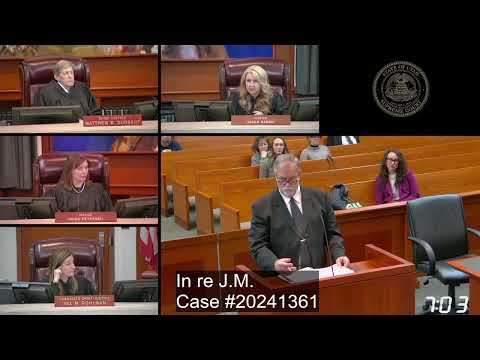
Utah Supreme Court hears dispute over whether prosecutors may file juvenile petitions after probation referrals
Summary
At oral argument in Enray JM, defense counsel argued juvenile diversion agreements should bar later criminal petitions; the state said prosecutors retain statutory authority to file petitions in cases not eligible for non‑judicial adjustment. The court took the case under advisement.
The Utah Supreme Court heard argument in Enray JM over whether prosecutors may independently file a petition against a juvenile after a law‑enforcement referral is routed to juvenile probation.
William Russell, attorney for the minor JM, told the court that "for decades, non‑judicial adjustment agreements, commonly called NJAs, have been the cornerstone diversion process within Utah's juvenile courts," arguing the statutory framework and rule changes reflect a legislative intent to keep low‑risk youth out of formal adjudication and to limit prosecutorial reach in juvenile matters. Russell said probation—an arm of the judicial branch—performs validated risk assessments and that referrals must flow through probation before prosecutorial review in most cases.
Jeff Man, counsel for the state, answered that the juvenile code gives prosecutors broad authority to file petitions in most juvenile cases and that a non‑judicial adjustment is a limited carveout for low‑level matters. "The non‑judicial adjustment was not authorized. It was illegal and therefore the prosecutor had the authority to file a petition," Man said, framing the dispute as whether the juvenile at issue was eligible for diversion under the governing statutes.
During extended questioning the justices explored hypotheticals—ranging from a juvenile mass‑shooting suspect to a bank robbery with a juvenile getaway driver—to probe how the referral and intake rules operate in urgent or complex cases. Counsel debated statutory provisions and rules identified in argument, including definitional provisions for a "formal referral," the intake provisions that trigger a 10‑day filing window when a minor is in temporary custody, and statutory sections the parties discussed as central to the issue (referral and prosecutorial authority provisions cited by counsel during argument).
The defense urged that NJAs that have been offered, accepted and partly performed create reliance interests and cited procedural rules that, in their view, restrict prosecutors from later filing a petition in such circumstances. The state countered that prosecutors retain the ability to review referrals and to file petitions when a child is not eligible for diversion—particularly when the referral or underlying police report "involves" felony conduct—and that the juvenile court remains the forum to resolve disputes about eligibility if a petition is filed.
Counsel also discussed practical intake issues: how referrals are transmitted to juvenile probation (often by email and uploaded into the CARE juvenile case management system), who has access to those files, and whether prosecutors routinely see referrals at intake. The parties differed on how often prosecution is involved at the preliminary stage and on which actor should bear responsibility when an initial referral contains errors about the level of offense.
Both sides acknowledged that the juvenile court can ultimately decide eligibility if a petition is filed and challenged, but they disputed whether the statutory and rule framework allows prosecutors to act after a diversion agreement has been entered and partially performed. The court heard argument on the meaning of specific code sections and rules, including whether the statutory language vests prosecutors with authority or simply prescribes procedural steps for starting a juvenile proceeding.
After extended questioning and rebuttal, the Utah Supreme Court took the case under advisement.