Get Full Government Meeting Transcripts, Videos, & Alerts Forever!
Get email alerts on the Statutory Interpretation topic
No spam. Unsubscribe anytime.
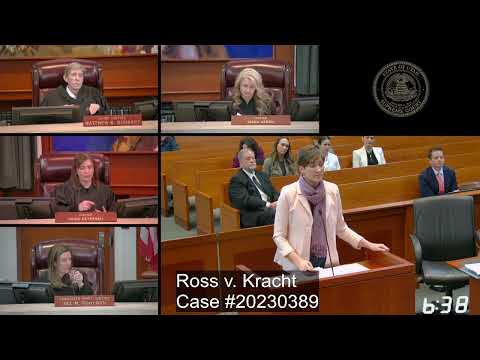
Utah Supreme Court considers whether 'strictly necessary' applies when parental rights end via adoption statute
Summary
At oral argument the justices pressed lawyers on whether the adoption statute imports the termination statute's "strictly necessary" requirement, probing amendments, precedent and whether district-court findings already satisfy the test. Counsel asked for reversal and remand; the court took the case under advisement.
The Utah Supreme Court heard argument over whether the "strictly necessary" element courts apply when terminating parental rights must be satisfied when termination is effected under the state adoption statute, 81-13-205, which cross-references the termination statute, 80-4-301. Appellate counsel told the court the dispute turns on statutory incorporation and on how to harmonize repeated amendments to the child-welfare code.
Appellate counsel (Emily Adams) told the court that "this case represents a straightforward question of whether the strictly necessary analysis applies uh when a termination is through the adoption act," and urged the justices to read the adoption act as incorporating the "grounds described" in the termination act rather than importing unrelated procedural provisions. Adams argued some overlapping language is best read as redundant drafting rather than a signal that the legislature excluded the strictly-necessary requirement.
Why it matters: the strictly-necessary inquiry—shaped by this court's prior decisions and by the court of appeals' BTB opinion—requires an on-the-record consideration of feasible alternatives to termination, counsel said. Adams told the court that the term "strictly necessary" was codified in pieces across amendments (noting changes in 2012, 2018 and 2024) and that the drafting history and case law support requiring the analysis before parental rights are terminated through an adoption filing.
Opposing counsel (Taylor Webb) told the justices the district court's findings already functionally satisfied the strictly-necessary inquiry and that remanding would be futile because the record shows repeated parental instability and failed alternatives. Webb said the parents had been "effectively forced to be away from the kids," argued alternatives such as guardianship had been tried and failed, and urged the Court to affirm on those factual grounds. Webb also urged the court to rely on harmless-error and alternative-grounds doctrines if the justices thought preservation was an issue.
Bench focus and questions: the justices pressed both sides on (1) whether the adoption act's reference to the termination act unambiguously sweeps in the strictly-necessary requirement, (2) whether the statutes should be harmonized by purpose (termination focused on parental rights; adoption focused on stability and finality), and (3) whether the district court's factual findings (danger to the children's health and safety; prior failures of less severe arrangements) already support termination even if the exact phrase "strictly necessary" was not used on the record.
Evidence and preservation: counsel acknowledged a contested preservation issue. Appellate counsel said constitutional-avoidance and absurdity can guide statutory interpretation even if some arguments were not fully developed below; opposing counsel stressed that the record contains a detailed factual history (including a protective order and prior custody events) that would make a remand unlikely to change the outcome. Counsel corrected one exchange on the bench about a protective order's duration, noting that Exhibit 43 showed the order expired in May 2024.
Outcome and next steps: after extended questioning the court thanked counsel and took the case under advisement. The justices did not announce any decision at argument. If the court rules that the adoption act requires a strictly-necessary finding, the decision could affect how private adoption petitions that rely on termination grounds are litigated going forward; if the court finds the district-court findings suffice, the ruling could narrow remands that seek additional on-the-record findings.
Sources: oral argument before the Utah Supreme Court; parties referenced 80-4-301 (termination act), 81-13-205 (adoption act), the BTB line of cases and Navarez (2015 Utah 34).