Get Full Government Meeting Transcripts, Videos, & Alerts Forever!
Get email alerts on the Injunctions Pending Appeal topic
No spam. Unsubscribe anytime.
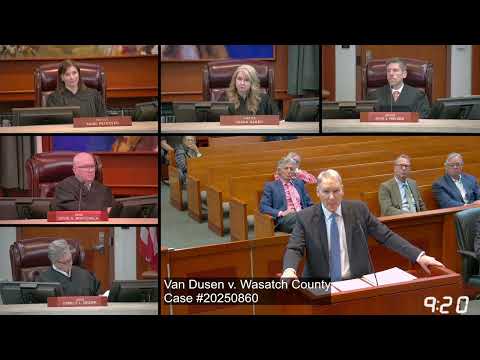
Utah Supreme Court weighs whether to suspend injunction halting Wasatch County temple construction
Summary
The Utah Supreme Court heard argument over whether a district-court injunction that paused construction of a temple in Wasatch County should be suspended. The panel focused on whether Rule 62C incorporates Rule 65A factors, whether Rule 8 permits this court to decide in the first instance, environmental and irreparable-harm evidence, and the sufficiency of the bond.
The Utah Supreme Court on oral argument Wednesday considered whether to suspend a district-court injunction that halted construction of a temple approved by Wasatch County, focusing on whether the standards for an injunction pending appeal (Rule 62C) incorporate the Rule 65A factors and on whether this court should act in the first instance under Rule 8.
One counsel opened by asking the court to vacate the district court’s injunction, arguing the trial judge applied an outdated “serious questions” or sliding-scale test rather than the court’s current standard. The attorney said that if Rule 65A’s factors are applicable, they should be those presently embodied in Rule 65A rather than an older iteration of the sliding-scale test.
The bench repeatedly pressed both sides on the interplay among Rule 8, Rule 62C and Rule 65A. Justice Peterson asked whether the Court was “reviewing what the district court did as we would in a direct appeal or should we actually be looking at this de novo and saying whether we believe that in an exercise of our authority we want to suspend the injunction.” Counsel for the party opposing the injunction urged that the result would be the same either way and that, given the appeal and loss of district-court jurisdiction on the merits, Rule 8 permits this court to decide whether to suspend the injunction in the first instance.
A second line of dispute concerned irreparable harm and the balance of equities. Petitioners’ counsel told the court that many of the claimed harms (traffic, lighting, long-term operation) do not materialize during a construction phase and that partial construction is not irreparable because, if the appeal succeeds, the county could require remediation or the structure could be removed. The attorney characterized the financial risk of proceeding during appeal as something the church could choose to assume.
Opposing counsel pressed environmental and construction-specific harms, including floodplain concerns and heavy dewatering during construction, and defended the district court’s decision to require security. Counsel pointed to factual findings by the county planning commission and county council and argued those findings support the injunction pending appeal.
The panel focused heavily on procedural posture. The transcript shows extended discussion of Jensen v. Schwendamman, the Tenth Circuit’s later decisions and this court’s own precedents such as Planned Parenthood v. State and Suarez v. Grand County, with judges probing whether earlier caselaw and federal analogues remain persuasive when a state rule’s plain language is emphasized.
The parties also debated bond and compensatory security: the district court set a $10,000 bond, which petitioners said was inadequate given claimed construction-cost inflation; opposing counsel contested the calculations and asked whether a multi-million-dollar bond would be legally or practically appropriate.
Both sides acknowledged some legal ambiguity. One counsel suggested the court could decide the motion by applying Rule 65A factors by consent of the parties, while the other emphasized that the county’s statutory land-use scheme (referred to variously in argument as KDMA/Cludma) and the council’s findings create a strong presumption that the legislative decision is at least “reasonably debatable.”
After extended questioning on standards of review, the sufficiency of the evidence on environmental harm, the effect of the county code (including a now-repealed automatic-stay provision that the parties discussed), and the proper remedy if the injunction is vacated, the panel took the matter under advisement.
The court did not announce a ruling at the hearing; the next step is an opinion resolving whether the injunction should be suspended or maintained and, if so, whether the bond or other conditions should be changed.