Get Full Government Meeting Transcripts, Videos, & Alerts Forever!
Get email alerts on the Coastal Protection Zoning topic
No spam. Unsubscribe anytime.
Santa Cruz planning panel backs ordinance amendments to require voter approval for onshore support facilities tied to offshore drilling and deep‑sea mining
Summary
The Planning Commission on May 7 recommended that the City Council consider amendments to Santa Cruz municipal code Title 24 that would require voter approval for any zoning changes to allow onshore support facilities for offshore oil and deep‑sea mining. Staff, Save Our Shores and local experts urged the measure to strengthen the city's "blue wall" protections and called the draft legally grounded.
The Santa Cruz City Planning Commission recommended on May 7 that the City Council consider amending municipal code Title 24 to require voter approval for zoning changes that would enable onshore support facilities for offshore oil and gas drilling and deep‑sea mining.
Staff presented the proposal as an update to the city's longtime coastal protections. "Requirements that any zoning change to accommodate support facilities for deep sea mining would be subject to a vote of the people," William Kelly, a climate action program staffer in the city manager's office, told commissioners. Kelly said the amendments build on Ordinance 85‑70 and add definitions, findings and procedures to municipal code Chapter 24.06 and specific zone provisions to preserve the historical "blue wall" approach.
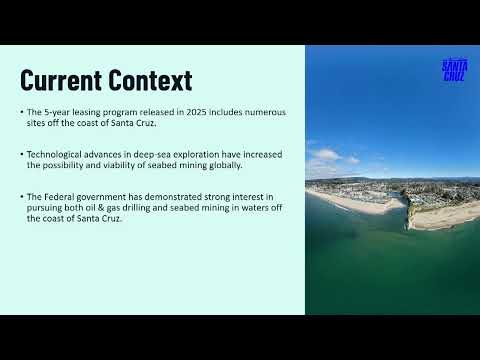
Why it matters: federal agencies in 2025 proposed new lease sales and signaled interest in deep‑sea mining in U.S. waters, prompting local jurisdictions to consider measures that limit onshore infrastructure that supports offshore extraction. City staff said the proposal is not an outright ban on support facilities but would add a procedural requirement — voter approval — for any zoning or legislative changes to allow them. Staff also noted ongoing discussions with the Coastal Commission about which provisions should be incorporated into the city's Local Coastal Program and said relevant provisions were evaluated under CEQA exemptions.
Save Our Shores, which worked with city staff and the Mills Legal Clinic at Stanford Law School on a model ordinance, urged commissioners to forward the amendments. "Santa Cruz was the first jurisdiction in the state to pass this type of ordinance, and now we're updating it to address offshore oil and seabed mining," Katie Thompson, executive director of Save Our Shores, said. George Leonard, a marine science and policy consultant working with the organization, told the commission the federal proposals are proceeding quickly and urged local precaution.
Commissioners asked whether a local vote would strengthen the ordinance's legal footing and whether the text could unintentionally affect renewable projects. Staff and the Mills Clinic review cited in the presentation said a public vote does not change the technical legal analysis but can build public support and help condition the political environment for future legal challenges. Staff emphasized the ordinance is drafted to avoid preemption problems and to limit unintended effects on renewable energy projects through careful definitions and exclusions.
What happened next: a commissioner moved and the commission voted to forward the staff recommendation to the City Council for formal hearings; the item is expected to be scheduled for the council's June hearings for first and second reading. The commission recorded the motion and a roll‑call yes vote to recommend approval.
Authorities and references in the hearing included Ordinance 85‑70, proposed municipal code sections (24.06 additions and specified zone changes), the Local Coastal Program, CEQA considerations, and the Bureau of Ocean Energy Management (BOEM) leasing process.
The Planning Commission discussion closed with staff and Save Our Shores noting outreach and coordination with neighboring jurisdictions, and the commission forwarded the matter to the City Council for its consideration and any decision about placing a measure on the ballot.