Get Full Government Meeting Transcripts, Videos, & Alerts Forever!
Get email alerts on the Healthcare Payments topic
No spam. Unsubscribe anytime.
CMS releases updated PEPPER for short‑term hospitals and opens new portal
Summary
The Centers for Medicare & Medicaid Services on March 18, 2026 released an updated PEPPER for short‑term acute care hospitals covering Q3 FY2023–Q4 FY2025 and announced a new PEPPER portal; the tool provides aggregated metrics to help hospitals spot billing patterns but does not identify improper payments or include patient‑level data.
The Centers for Medicare & Medicaid Services released an updated PEPPER (Program for Evaluating Payment Patterns Electronic Report) for short‑term acute care hospitals on March 18, 2026, and provided access to a new PEPPER portal intended to let hospital users download individualized PEPPER workbooks and compare metrics within their MAC jurisdiction, state and nationally. Hannah Klein, a member of the PEPPER project team at CMS, said the March 18 release covers data from quarter 3 of fiscal year 2023 through quarter 4 of fiscal year 2025.
Klein said PEPPER is an educational tool, not an enforcement product. "PEPPER does not identify improper Medicare payments," she said. "Rather, it is an educational tool for providers to help identify payment patterns that indicate areas of risk for improper payments so that they may be reviewed further." The short‑term release is limited to hospitals with at least 11 claims in a given target area for the quarter; PEPPER for other facility types will be released later in the year, Klein added.
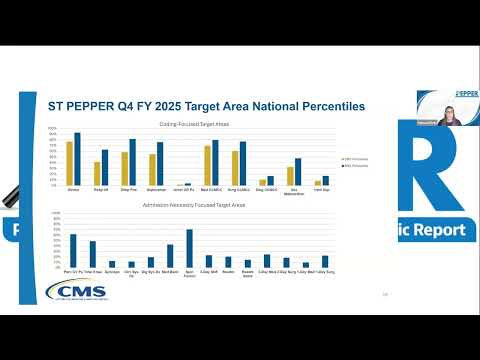
Dawn Strawser, a member of the PEPPER project team at CMS, walked attendees through the PEPPER workbook format. The report is delivered as an Excel workbook with separate tabs for purpose and scope (including the hospital CMS certification number, or CCN), target area definitions (numerator/denominator logic), a target‑area comparison report, a national high‑outlier ranking report and detailed results for each of the 24 target areas. Strawser noted that coding‑focused target areas include both low and high outlier bounds while admission‑necessity target areas report only high outliers.
Klein and Strawser demonstrated how target‑area percentages are calculated and how outlier status is assigned. Using the example presented, a national 20th percentile of 10.6% and an 80th percentile of 16.9% would make a hospital with a 13.4% target‑area percentage a non‑outlier and a hospital with a 48% percentage a high outlier. Klein said those percentile benchmarks are the basis for low/high flags and that the PEPPER highlights high outliers for all 24 target areas and low outliers for the coding‑focused subset.
The PEPPER portal is accessible from the CMS PEPPER webpage but requires a CMS Identity and Access Management (INA) account and registration as a staff end user, authorizing official (AO) or access manager (AM) with the PEPPER business function. "To access the new portal, you will need to have an account with the CMS identity and access management system, INA, and be registered as a staff end user, authorized official, or access manager for your organization with the PEPPER business function," Klein said. CMS said organizations should contact their AO or AM or the External User Services (EUS) help desk if they have problems; the team cannot grant access directly.
Panelists answered attendee questions about scope and data elements. Dawn Strawser clarified that readmission counts are not limited to readmissions for the same diagnosis; the readmission target area counts readmissions regardless of diagnosis. Attendees asked whether inpatient‑only (IPO) procedures had been removed from the 1‑day surgical target area; panel members confirmed IPO procedures billed with ICD‑10‑PCS are included when the DRG is surgical and noted the report provides supplemental tables to help interpret those counts.
The PEPPER reports do not contain patient‑level identifiable information. Klein said the reports provide aggregated metrics designed to help hospitals identify claims for further local review: "The PEPPER does not have patient‑specific information that can be shared." CMS also said individual facility PEPPERs are not posted publicly; a sample PEPPER workbook is available on the PEPPER website and CMS notifies authorized officials and access managers when reports are published. Notifications are also posted on CMS social channels and via the Medicare Learning Network.
What to do next: hospitals seeking access should confirm an AO or AM has added the PEPPER business function to their INA account; if they do not know their AO or AM, CMS advised contacting the External User Services help desk. CMS said PEPPERs for other facility types and related CBR products will be published in coming months, and the agency will host additional webinars as new reports are released.
The webinar recording, slides, transcript and Q&A will be posted on the PEPPER website, and CMS asked attendees to complete a post‑webinar survey.