Get Full Government Meeting Transcripts, Videos, & Alerts Forever!
Get email alerts on the Short Term Rental Ordinance topic
No spam. Unsubscribe anytime.
Bakersfield panel backs short‑term rental rules, sends ordinance to council
Summary
The Planning Commission voted to recommend a new short‑term rental ordinance to City Council, approving a framework that would require annual, nontransferable permits, 24/7 emergency contacts, inspections and a 20% cap on units in multiunit complexes; staff estimates the measure could generate roughly $1 million in transient‑occupancy tax revenue annually.
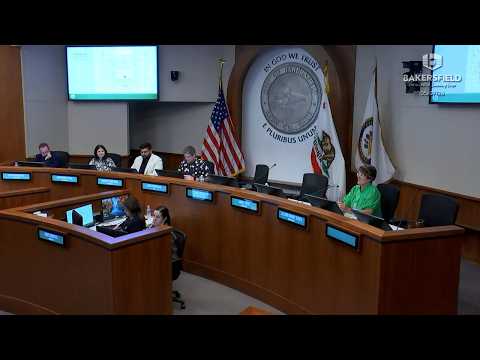
The City of Bakersfield Planning Commission on May 7 voted to forward a proposed short‑term rental ordinance to the City Council for first reading, recommending a package of permit, enforcement and tax‑collection measures intended to regulate Airbnbs and similar short‑term rentals.
City attorney’s office staff VD King and Mr. Burns presented the draft ordinance, saying it would create a 1‑year, nontransferable STR permit requiring operators to provide a 24/7 emergency contact, proof of ownership or notarized owner release if the operator is not the owner, and an inspection for hazardous or unsafe conditions before a permit is issued. King said ADUs, junior ADUs, deed‑restricted affordable units and special‑group residences would be excluded from STR eligibility under state law and the draft language.
"The permit would require the operator to submit an application and identify an emergency contact person that will be available 24 hours a day, seven days a week," King said during the presentation.
The draft ordinance also proposes a cap limiting STR permits to 20% of dwelling units within an apartment or condominium complex and requires permitted listings to display a permit number and expiration date to help staff verify compliance. Burns told commissioners the city plans to contract with a third‑party vendor to perform data scraping, take initial complaint reports and assist with transient‑occupancy‑tax (TOT) collection.
Commissioners asked staff a range of implementation questions, including how enforcement had been handled while STRs were effectively illegal under Bakersfield’s permissive zoning. King said enforcement to date has been largely complaint driven and consists mainly of cease‑and‑desist letters, and that staff receives only a handful of complaints each year.
Commissioner Martin pressed staff on cost implications for operators, asking about likely permit fees and insurance requirements. "What's our insurance minimums that we're asking people?" Martin asked. King responded, "I believe it's $1,000,000. I believe it was $1,000,000 for the insurance. That's our standard amount that we ask for any contractor or contract that we have with the city."
On revenue and fees, staff estimated a city‑collected TOT of about 12% of nightly rental cost and suggested the combined number of unpermitted STRs in Bakersfield could generate ‘‘somewhere between $1,000,000 and $1,500,000’’ in TOT annually if brought into compliance, a figure cited during commissioner questioning.
Commissioners debated whether to require a more rigorous conditional‑use or community‑notice process for permits and discussed the tradeoffs between neighborhood notice and administrative efficiency. Commissioner Brent Oliver urged more notice for nearby residents, while others said no top‑10 city consulted in staff’s research required a CUP and that the ordinance can be amended later.
Commissioner Martin moved to support staff’s recommendation to send the ordinance and its notice of exemption to council; the motion carried. The commission’s recommendation does not change the ordinance’s text; it refers the draft to the City Council, which will hold first and second readings and set an effective date if it adopts the ordinance.
The next steps: the draft ordinance is scheduled for City Council first reading; staff said the council could make edits at first reading, the ordinance would return for second reading, and it would take effect 30 days after the council’s final action.