Get Full Government Meeting Transcripts, Videos, & Alerts Forever!
Get email alerts on the Edtech Opt Outs topic
No spam. Unsubscribe anytime.
Parents and advocates urge Los Angeles Unified to curb classroom technology and deliver opt‑out petitions
Summary
More than a dozen parents and members of Schools Beyond Screens told the Los Angeles Unified School District board that early‑grade device use and platforms such as YouTube harm learning, handed the district a stack of 142 opt‑out letters and demanded clearer opt‑out rules and limits on edtech.
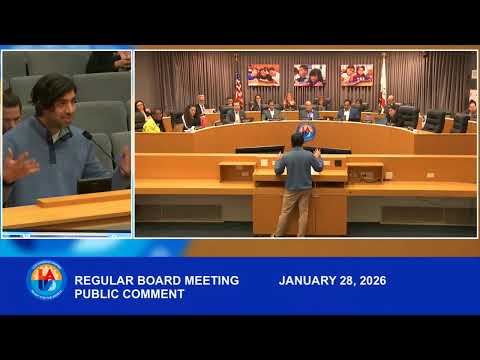
At the Jan. 28 Los Angeles Unified School District (LAUSD) board meeting, parents and advocacy groups urged trustees to limit classroom technology, demand clearer opt‑out procedures and block access to platforms such as YouTube in young grades.
The public‑comment period was dominated by speakers representing Schools Beyond Screens, parents from multiple LAUSD schools and a licensed child psychologist who said early reliance on screens undermines literacy, attention and social development. "Screens can wait, childhood cannot," Nichollet Santos told the board. "Technology should support learning, not replace these experiences," she said.
Many speakers asked the district to make explicit that parents may opt their children out of device‑based instruction. Todd Grabbarski, who said he is a parent at a Title I school, said the chief academic officer confirmed that "the I‑Ready personalized instruction minutes are not mandated by the district," but that principals and teachers continue to tell parents they are required. "Can the district publicly communicate full‑throated, unequivocally that the I‑Ready personalized instruction minutes are not required?" Grabbarski asked.
Christina Brown, a parent at Mitchell Terrina Elementary, handed the superintendent a physical stack of opt‑out letters and told trustees: "I just handed you a stack of 142 opt‑out letters from our school. 142 families want to opt their kids out of screen‑based learning." Brown said whole classes at her school have opted out and urged other parents to organize.
Speakers including Bridey Lee and Sandra Martinez framed the issue as a broader public‑health and equity concern. "Big tech is the big tobacco of our time," Lee said, urging the district to block YouTube. Martinez, representing Schools Beyond Screens, said edtech vendors promised data‑driven improvements that she said have not materialized and warned that increased device time worsens literacy and attention problems.
Dr. Deanna Iikinstein, a licensed child psychologist and Schools Beyond Screens member, pointed to other districts that have limited classroom tech and called for LAUSD to adopt age‑appropriate rules. "Why ban phones yet give iPads to kindergarteners?" she asked, citing examples of Baltimore County and the San Marcos Unified School District.
Separately, several parents raised special‑education concerns and staffing issues: Carol Verde and Diana Gillen alleged inadequate support for students with IEPs after a history teacher was removed, said parents were mocked by district staff and called for the district to produce the relevant policies and records. The board did not respond substantively during public comment, with the clerk noting Brown Act limits on board discussion during that time.
The public comment period also included calls for increased school safety and a return of uniformed school police from Isabelle Gonzalez and Marcela Garcia, who cited violence, drugs and staffing shortages for psychologists and nurses.
The board recessed into closed session after public comment and later reported expulsions and multiple personnel appointments without taking immediate public action on the edtech requests.
Why it matters: Parents and local advocacy groups signaled organized opposition to current classroom tech practices and presented the board with a formal petition (142 opt‑out letters from one school). Trustees face pressure to reconcile district memos, school‑level practice and parent demands about opt‑outs, vendor contracts and age‑appropriate device use.
What's next: Several speakers called on the district to publish a clear opt‑out process and to review device policies; the district may address those matters in staff reports or future agenda items.