Get Full Government Meeting Transcripts, Videos, & Alerts Forever!
Get email alerts on the Medication Repository topic
No spam. Unsubscribe anytime.
Committee backs bill to ease paperwork and expand Minnesota medication repository
Summary
A Minnesota House committee recommended House File 3917 to the General Register after testimony that the state—s medication repository (Roundtable RRx) redirects millions in otherwise-wasted drugs to people in need and seeks statutory clarification to reduce recordkeeping and use previously appropriated funds for operations.
A Minnesota House committee on the 2026 Legislature MN calendar voted to recommend House File 3917 for placement on the General Register after testimony that the state—s medication repository program reduces waste and expands access to prescription medicines for low-income Minnesotans.
Representative Mahmoud introduced the bill, saying it would streamline the repository—s operations and free up previously appropriated funds. "This bill will help the repository," Representative Mahmoud said, and called Dr. Rowan Man to testify.
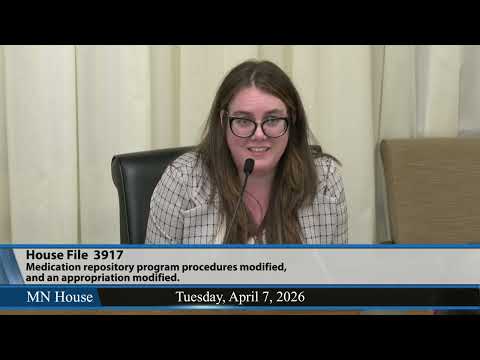
Dr. Rowan Man, a pharmacist who leads the Minnesota Medication Repository program known in testimony as Roundtable RRx, told the committee the initiative recovers and redistributes medications that otherwise would be destroyed. "It is estimated that Minnesotans destroy approximately 16 million dollars worth of unused medications every year," Dr. Man said. He said the program accepts properly packaged, non-controlled medications, subjects them to pharmacist safety checks, and distributes them through partnerships with pharmacies and clinics. "We currently have dispensing partners in 26 Minnesota counties," he said, adding the program operated at "approximately a 4 to one return" and kept "over 5 million doses out of the landfills and water systems this fiscal year."
Dr. Man asked the committee for two practical changes: statutory clarification so destruction-record requirements would apply only to medications formally accepted into inventory (he said this would reduce an administrative burden without changing safety oversight), and flexibility to use funds already appropriated to support necessary operational costs such as compliant home delivery to improve rural access. He said he had reviewed the clarification with the Minnesota Board of Pharmacy and the Minnesota Pollution Control Agency and found no compliance concerns.
Committee members asked about fiscal impacts and program volume. Dr. Man said the bill does not request new appropriations but would free up about $250,000 previously appropriated so the repository could expand operations; he reported the program redistributed about $1.8 million worth of medications in the previous year. When asked about controlled substances, Dr. Man said, "The repository does not accept any controlled substances."
With no further questions, the chair renewed the motion to recommend House File 3917 for placement on the General Register; the committee approved the motion by voice vote.
The bill will proceed to the General Register, where it may receive further floor consideration.