Get Full Government Meeting Transcripts, Videos, & Alerts Forever!
Get email alerts on the Behavioral Health Trc topic
No spam. Unsubscribe anytime.
Consultants and staff flag capacity, finance and staffing challenges at Douglas County TRC
Summary
Douglas County commissioners reviewed an interim TRC consultation on April 22, 2026. Consultants told the board KDADS licensing caps the facility at 16 beds (the building was designed for 32), and highlighted unresolved financial, data-alignment and staffing issues; a final report is due in May.
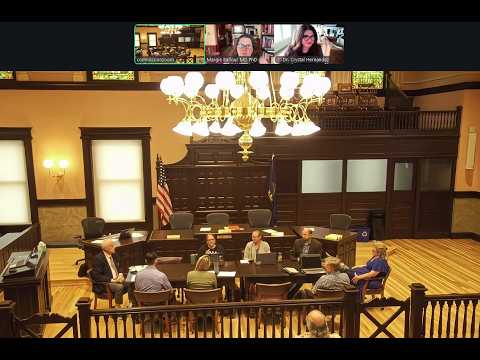
Douglas County commissioners on April 22 heard an interim report on the Treatment and Recovery Center (TRC), where consultants and Bert Nash leadership described a mismatch between the facility's design and current Kansas licensing, and outlined remaining questions about finances, data and staffing.
The consultants, led by Margie Balffor and Dr. Crystal Hernandez, told the board they completed phase one of a consultation and issued an interim memo with a final report expected in May. "The community really values the TRC," Balffor said, but the team found operational and financial issues that need further work.
Why it matters: the building was designed for up to 32 people, but KDADS licensing limits on admissions and observation/stabilization mixes cap capacity at 16 (for example, 2 and 14 or 6 and 10), a constraint consultants said differs from the financial model used when the facility was planned. That mismatch affects projections of Medicaid and PPS reimbursements and overall sustainability.
What staff told commissioners: Kirsten Watkins, CEO of Bert Nash, said consultants and new finance staff are separating TRC costs into "three buckets" to determine the true cost of rendering that level of care and to update the PPS cost-reporting needed to set sustainable reimbursement rates. She noted the agency "was required to submit our information for that cost report to the state last Wednesday," and staff are awaiting updated PPS-rate guidance.
Operations and data: consultants recommended aligning definitions and metrics among EMS, the emergency department and the TRC so transfers and outcomes are reported consistently. Balffor said that current reporting practices do not always align across partners and recommended using automated dashboards (for example, PowerBI) so TRC staff can spend time analyzing rather than producing routine reports.
Staffing, training and safety: Ryan Storch, crisis services senior director with Bert Nash, described a 3–4 day deep-dive crisis de-escalation training they use and said leadership is adding safety tools (two security points, Vera Bluetooth devices, radios for mobile response teams). He and others stressed the need for a medical director and mentorship to grow clinicians into facility-based roles. "We're still teaching what a crisis intervention center is; that's where a lot of that work is continuing to build," Storch said.
Use patterns: staff presented utilization figures they said the county collects: roughly 1,200–1,300 unique individuals and about 3,500 visits annually, with roughly 1,500 admissions to observation or stabilization units; at any given time the "familiar faces" list has about 14 people who cycle through repeatedly. Staff also reported an 18% decrease in admissions to observation/stabilization the year after the KDADS capacity cap went into effect.
Partnerships and next steps: speakers described ongoing coordination with EMS, law enforcement, emergency departments and substance-use providers and said they are developing flowcharts and diversion protocols that clarify who can cap admissions and who must be notified. Consultants said they will follow up on finance and operational details and expect to finish a final report in May; staff aim to present more detailed financial material to the commissioners ahead of or at the May 20 meeting, though the final consultant report may not be complete by then.
No board action or vote was taken at the work session; commissioners asked for more detailed financial materials and for follow-up presentations as consultants finish their analysis.
The TRC interim memo is attached to the county packet; consultants told the board they will return with a final report and specific recommendations next month.