Get Full Government Meeting Transcripts, Videos, & Alerts Forever!
Get email alerts on the Oversight Report Adoption topic
No spam. Unsubscribe anytime.
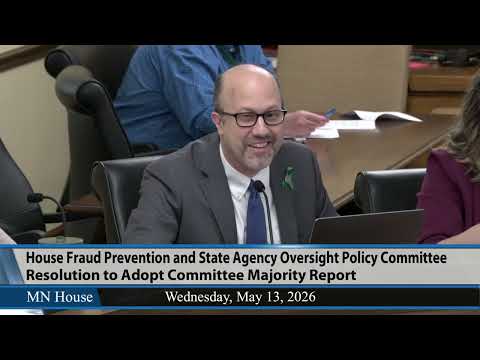
House oversight panel adopts majority report, renews call for fraud controls after heated debate
Summary
The Minnesota House Fraud Prevention and State Agency Oversight Committee adopted a majority report on May 5, 2026, detailing patterns of fraud across child care, Medicaid waiver services and related programs and urging immediate reforms; the vote followed sharp debate over the report's timing and partisan framing.
The Minnesota House Fraud Prevention and State Agency Oversight Committee on May 5 adopted its majority report on fraud across state programs and urged the next Legislature to reconstitute an oversight body and implement recommended controls.
The report, which the committee's chair moved to adopt and Vice Chair Anderson seconded, catalogues recurring fraud "business models" in programs including child care, the Feeding Our Future program, multiple Medicaid waiver services, housing stabilization and non-emergency medical transportation. The committee recommends steps such as declaring high-risk programs earlier, using prepayment reviews and conducting unannounced site inspections.
Why it matters: committee members said the report exposes systemic patterns that have allowed criminals and abusive providers to exploit programs meant for vulnerable Minnesotans, while opponents argued the document was rushed and politically slanted. The majority framed the report as a roadmap for immediate reforms and for follow-up in the next biennium.
The debate: Minority members objected to the timing and tone of the report, saying an 80-page document was posted less than 24 hours before the vote and calling parts of it "partisan nonsense." One member argued the committee had mischaracterized the attorney general's record on Medicaid prosecutions and said Democrats were not given sufficient opportunity to review or contribute to the document.
The chair replied that the oversight committee's role is investigative and that producing separate majority and minority reports is a recognized oversight practice. The chair also said she had requested detailed records from the attorney general's office, noting that while some recoveries (an $80 million figure was cited during discussion) have been reported, those amounts are small compared with the committee's estimated scope of fraud and that additional documentation was requested for the public record.
Member reactions: Representative Pinto called the report "a real missed opportunity" for bipartisan solutions and criticized what he described as partisan framing. Representative Schultz defended the committee's work, saying hearings and agency presentations were part of a two-year inquiry that produced recommendations taken up elsewhere in the Legislature.
Representative Nash praised the committee's investigative role, saying the panel had helped "make fraud unacceptable" and had driven reforms that other committees and departments have begun to implement.
Vote and next steps: After debate the chair called a roll call and announced the report adopted; the transcript records the chair's announcement of the roll call as: "I therefore eyes at 2 ABSTAINS 0 nays and excused absence." Minority members were reminded that a minority report may be filed by Friday. The committee then adjourned.
The committee's recommendations include multiple administrative and statutory actions intended to strengthen internal controls and improve whistleblower protections; the majority urged the incoming Legislature to act on those recommendations in the next biennium.