Get Full Government Meeting Transcripts, Videos, & Alerts Forever!
Get email alerts on the Traffic Calming topic
No spam. Unsubscribe anytime.
Designers propose speed cushions, diverters and a traffic circle for Aklland Park Drive as part of Athena Bikeways
Summary
At a May 7, 2026 public meeting, project designers and NDOT staff presented a traffic-calming concept for the Aklland Park segment of the Athena Bikeways, proposing speed cushions, bulbouts, diverters and a small traffic circle to address cut-through traffic and improve pedestrian and bicycle safety; residents pressed for sidewalks and funding clarity.
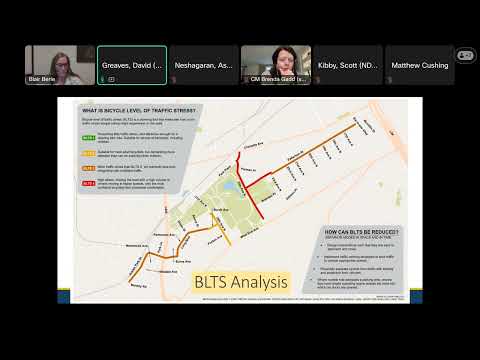
Design consultants and NDOT officials on May 7 presented a traffic-calming plan for the Aklland Park portion of the Athena Bikeways that relies on speed cushions, bulbouts, two vehicle diverters and a small traffic circle to reduce vehicle speeds and through-traffic while preserving bike and pedestrian access.
“None of these streets we’re working on are so wide that we have room to do the best possible facility,” said David Greavves, a design consultant with Kimley Horn, explaining why the team favored traffic-calming and volume-management measures over buffered bike lanes. Greavves said the team measured 3,743 vehicles on Aklland Park Drive during their study period, found an average speed of 22 mph and an 85th-percentile speed of 27 mph, and recorded nine vehicular crashes in the corridor over the past 10 years; the study showed no reported pedestrian or cyclist crashes in the project extent.
The proposed design package includes modular speed cushions spaced lightly along Aklland Park Drive to keep speeds near the 20-mph neighborhood target; bulbouts at the Nebraska–Aklland Park intersection to shorten crossings and improve sight lines; a yield-only traffic circle at Aklland Park Drive and Long Boulevard to calm intersection speeds; and diverters at Park Circle and Renwood designed to block through-vehicle movements while allowing people walking and biking to pass. Greavves said diverters are intended to move cut-through traffic back to collector streets such as Murphy Road.
Scott Kibby, representing NDOT’s multimodal group, said funding for the bikeway portion is included in the fiscal year 2026 capital spending plan and that traffic-calming work typically comes from a Vision Zero or multimodal allocation. He described the department’s process: intake and vetting of projects, design, community engagement, balloting for some neighborhood traffic-calming programs, and construction if approved.
Several residents and a council member pressed the team about sidewalks. Greavves answered directly that the Aklland Park project will not include new sidewalks: “this project will not have sidewalks included in it,” he said, explaining that adding curb, gutter and sidewalks often triggers stormwater and utility relocations and a different scope of work and review.
Attendees described gaps in continuous sidewalks and a difficult greenway crossing at the 440 bridge where drivers sometimes fail to stop. A council member and staff also said a prior legal challenge had affected how the city funds some sidewalk work, leaving some sidewalk money set aside and subject to reclamation by developers per court orders; NDOT and council representatives urged continued outreach and said corridor-level programs such as the city’s “choose how you move” prioritization can free capacity for future sidewalk investments.
Community members raised concerns that diverters could reduce local driving convenience and “disconnect” circulation for residents who currently use Aklland Park as a common local route. Greavves acknowledged trade-offs, saying diverters may make the route less convenient for cut-through drivers but that the design team seeks to avoid imposing hardship on adjacent blocks by combining diverters and analyzing connectivity.
A transportation planner suggested exploring paired one-way conversions on parallel streets to free space for pedestrian facilities or tactical delineation; the project team said it would evaluate that option as part of the next design phase.
Next steps: the project team will study the one-way option, finalize 60% design plans, route the designs through internal Metro reviews (including NDOT, Metro Parks and the fire department), and target construction in early 2027. The team also plans an evaluation-and-adjustment period after installation to address any unintended consequences. The project website hosts the 30% designs and a registration link for a community bike ride on May 23, 2026 at 10 a.m.
The meeting produced no formal votes or motions; instead the session served to gather input that the design team said will inform the 60% plans and departmental reviews.