Get Full Government Meeting Transcripts, Videos, & Alerts Forever!
Get email alerts on the Data Centers topic
No spam. Unsubscribe anytime.
Residents press Leavenworth County to pause ‘Project Blue Stem’; commissioners move for 90‑day moratorium
Summary
After more than two hours of public comment raising water, wildlife, tax and transparency concerns about a proposed Cloverleaf data‑center ("Project Blue Stem"), a commissioner moved to adopt a 90‑day moratorium on data‑center, battery storage and crypto facilities while the county studies regulations and holds additional hearings.
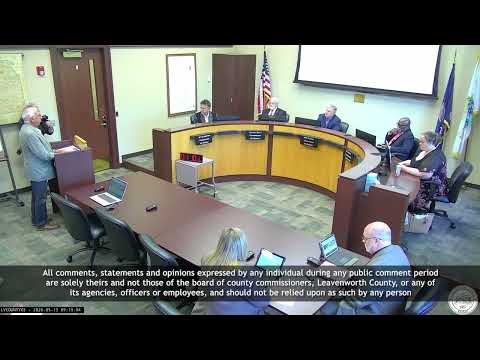
Leavenworth County officials on May 13 faced sustained public opposition to a proposed large data center often described in materials as “Project Blue Stem” or by the developer Cloverleaf LLC, and a commissioner moved to impose a 90‑day moratorium on new data‑center, battery storage and crypto facility proposals.
Residents spoke at length during an extended public‑comment period, calling for an independent review of developer materials and the fiscal assumptions underlying state incentives. "These glossy sales pieces have no cited scientific sources," said D. Carl Skankton of 24542 Cantrail Road, who challenged shifting claims about the project’s size and acreage and asked whether neutral hydrogeologic and noise studies would be completed and published before any final approvals.
Another speaker, Jim Carl of Tonganoxy, told the board he had heard that a county commissioner had passed out developer brochures at local meetings and urged stricter disclosure. "When a commissioner appears to be coordinating messages, it blurs a critical line," Jim Carl said, asking the county to pledge neutrality until facts are independently verified.
Several other residents raised environmental and quality‑of‑life concerns, describing the proposed site as wildlife habitat and warning of traffic, diesel emissions and the loss of groundwater and native soils. Elizabeth Grath read language from Kansas’ Senate Bill 98, which provides sales‑tax exemptions for qualifying data‑center construction and equipment, and cited a recent North American Electric Reliability Corporation notice flagging grid risks tied to large computational loads.
In response to the public comment, a commissioner said they had surveyed constituents and found strong local opposition; that commissioner then made a motion seeking a 90‑day moratorium on "further development of Project Blue Stem or any other data center proposal, battery storage facility or crypto storage facility" so the county could adopt regulations and hold additional work sessions and hearings. Another commissioner seconded the motion and discussion followed about whether a pause would be used to block projects or to gather more information.
Commissioners framed the moratorium largely as a temporary pause to obtain additional studies and public input. At the county’s work session earlier the county had heard from state and utility representatives that responsibility for different policy pieces — economic regulation, water permitting and grid reliability — is divided among state agencies. Several commissioners said that gap in state guidance and the rapid pace of data‑center proposals argued in favor of time to develop local rules.
The record in the county meeting transcript does not include a roll‑call vote tally for the moratorium motion; meeting audio and minutes should be consulted for an official outcome. The hearing record shows the motion was moved and seconded and that commissioners debated next steps and community outreach during the meeting.
What happens next: Commissioners said they expect to schedule work sessions and additional hearings during the moratorium period to gather independent analyses and to consider regulations addressing water use, noise abatement, grid impacts and the county’s tax policy. Residents who spoke asked that all studies and communications with the developer be published before any contract or endorsement is considered.