Get email alerts on the Housing Statutory Compliance topic
No spam. Unsubscribe anytime.
Planning commission unanimously backs code changes to meet state housing deadlines
Summary
Wilsonville Planning Commission voted 5–0 to recommend City Council adopt development‑code amendments implementing state housing laws (SB 974, HB 4037), including expanded public‑notice requirements and reclassification of certain residential reviews from administrative to Type II. Staff said the package aims to balance statutory mandates with local process efficiencies.
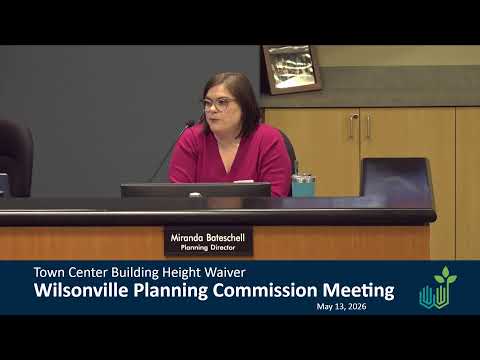
The Wilsonville Planning Commission voted unanimously on May 13 to adopt Resolution LP26‑00002, recommending that City Council approve the first phase of development‑code amendments to comply with recent state housing legislation. The commission moved and seconded the staff‑recommended resolution and recorded the outcome as a 5‑0 vote.
Senior planner Kim Ryold and consultant Heather Austin presented the ordinance package and its rationale. Austin told the commission that “Senate Bill 974 in 2025, 437 in 2026. Both are required to be put into place by all cities in Oregon July 1st of 2026,” and said the amendments are intended to bring Wilsonville’s code into statutory compliance while preserving a customer‑friendly review process.
Why it matters: the edits would change how the city processes residential development and related land‑use actions. Key changes summarized by staff include: requiring more applications to be handled as Type II reviews (staff level with public notice), increasing mailed‑notice radius to 100 feet, lengthening the class‑2 notice period to 14 days (from 10), clarifying what qualifies as “residential development,” and updating appeal rights so that appeals on certain clear‑and‑objective standards are limited to applicants in specific cases.
Staff also proposed administrative‑practice updates that are not strictly statutory: raising the square‑foot threshold for Class‑2 modifications (from 1,250 to up to 10,000 sq ft in some cases while retaining a 25% site/building cap), adding expiration dates to pre‑application meetings, cleaning up inconsistent review timelines to reflect the state’s 120‑day statutory windows, and consolidating the Development Review Board to a single seven‑member panel with more predictable meeting cadence beginning January 2027.
Commissioners asked for clarification about where the city’s proposals are more or less restrictive than state mandates, how clear‑and‑objective standards will affect design flexibility, and how notice and subscription options (email alerts, social media, Let’s Talk Wilsonville) can be used to broaden public outreach. Ryold and Austin said the packet’s index table identifies which amendments implement statutory requirements and which are local efficiency or policy choices.
The motion: a commissioner moved to adopt Resolution LP26‑00002 recommending City Council adopt the Phase One housing statutory compliance code amendments; a second was called and the commission approved the measure unanimously (vote recorded as five to zero). Staff will forward the commission’s recommendation to City Council for a public hearing and final decision.
What comes next: staff said the City Council will review the recommendation at an upcoming work session; if Council adopts the amendments they would ideally take effect before July 1, 2026, the date when statutory requirements begin to apply directly to jurisdictions that have not adopted compliant code language.
AI generated
The text on this page is AI generated. Summaries, highlights, analysis, and video transcripts are all produced from the original source material.
AI can make mistakes, so if you spot one, and we will fix it for everyone.
Note: the source content is unaltered by us. Any content source we link to, be it a video, an audio recording, or a document, is presented exactly as its publisher released it. That publisher is usually a government body, sometimes an individual official or another organisation.