Get Full Government Meeting Transcripts, Videos, & Alerts Forever!
Get email alerts on the Capitol Security topic
No spam. Unsubscribe anytime.
Conference committee reviews competing Capitol-security packages, discusses new legislative services unit and data-practice limits on reporting
Summary
Members compared House and Senate security language, fiscal staff reviewed differing appropriations for Capitol security and courts, nonpartisan staff introduced Amendment A8 to revise the Legislative Services Unit framework, and public-safety officials urged funding for weapons screening, State Patrol needs, and behavioral threat-assessment resources; no votes were taken that day.
The Safety and Security Conference Committee met May 13 to compare competing House and Senate security bills and to discuss an amendment (A8) that would change how a Legislative Services/Protective Services Unit would operate.
Nonpartisan staff led members through a side-by-side document showing differences in statutory structure and appropriations. Staff noted that the Senate language extends some services to "principal state officials," while the House language focuses responsibilities on protecting legislators and establishes a separate Legislative Services Unit. Staff also described Senate-only provisions to require removal of identifying insignia from emergency vehicles sold to the public and estimated related civil-penalty revenues. Fiscal staff highlighted different cost estimates for court and Capitol security items and pointed out a $2 million open appropriation item that needed to be rolled into totals.
An amendment labeled A8 (TES 34 32 A 8) was presented for discussion. Staff said the amendment would revise appropriation riders, reorganize emergency-contact and data-access language, remove a House-only entitlement for personal protective services and instead create statutory guidance and operational duties for the new Legislative Services Unit, expand threat-assessment and implementation directives, and add reimbursement provisions for local agencies providing protection. Staff characterized the amendment as presented for discussion rather than immediate adoption.
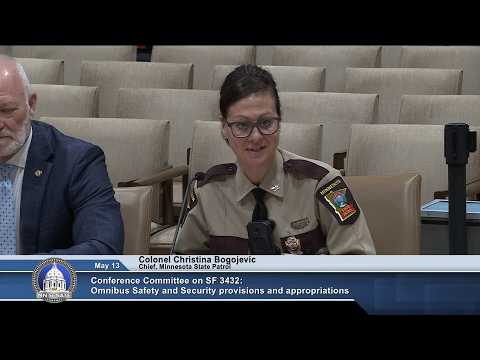
Commissioner Bob Jacobsen of the Minnesota Department of Public Safety called weapons screening and State Patrol support "critical," citing recent extraordinary events and mutual-aid demands that have stressed staffing. "Weapons screening was one of the highest priority recommendations" of a recent Capitol security review, he said, and implementing ongoing screening will require sustained funding. Colonel Kristina Vogel of the Minnesota State Patrol told the committee the agency has deployed large numbers of troopers in recent events and said staffing, training and technology upgrades are needed if the patrol is to assume an expanded investigative and protective role. She recommended maintaining multiple screening points during business hours and said the unit will require appropriate funding to operate.
Matt Dealing of Minnesotans for Open Government urged the committee to adopt the Senate reporting approach rather than the House approach, warning that the House language could create an entire "not-public" report and reduce public transparency about security spending. Nonpartisan staff said the intent is to protect truly sensitive operational details while keeping public accountability for budgets, and staff noted cross-references to existing data-practices protections (13.37) used in other legislative contexts.
Committee members discussed which security requests are bond-eligible versus appropriate for the general fund and asked the State Patrol for detailed cost breakdowns of the operating deficiency. After questions and additional discussion, the committee recessed; no votes or formal adoptions were recorded that day.