Get Full Government Meeting Transcripts, Videos, & Alerts Forever!
Get email alerts on the Accessibility Policy topic
No spam. Unsubscribe anytime.
Santa Monica ADA coordinator outlines playground upgrades, web‑access plan and housing/parking guidance
Summary
ADA coordinator Blake Stavros updated the Disabilities Commission on Douglas Park and other accessible playgrounds, an upcoming facility accessibility CIP request for FY26–28, and the city's web‑accessibility work (deadline extended). He answered detailed questions about ADA vs. FHA/Section 504, assigned accessible parking, and when federal funding triggers Section 504 requirements.
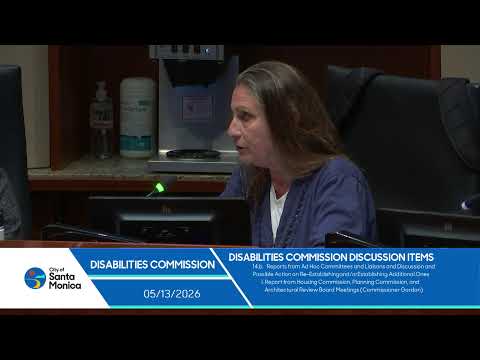
Blake Stavros, Santa Monica’s ADA coordinator, briefed the Disabilities Commission on local accessibility improvements and legal guidance for housing and parking at the commission’s May meeting.
Stavros highlighted recent and planned projects: Douglas Park’s newly reopened accessible playground, accessible features being added at the 19th Street Community Garden (an ADA‑accessible pathway and raised planters expected to open in June), and renovations at the Annenberg Beach House to improve access to all levels of the site. He said nearly half of the city’s playgrounds are now fully ADA accessible and that Virginia Avenue Playground is next on his list for upgrades.
On web accessibility, Stavros said the statewide deadline was extended by one year but the city will continue its planned work: "We are continuing to move forward with our efforts that's planned," he told commissioners, noting City ISD has implemented Siteimprove and the city is migrating legacy sites (including bigbluebus.com and smgov.net) into the primary CMS.
Stavros spent most of the meeting answering commissioners’ technical questions about overlapping authorities. He clarified that the ADA’s different titles cover employment, state and local government, and public accommodations, and that residential interior units are generally governed by the Fair Housing Act (FHA). He said Section 504 applies when federal funding is used for construction or maintenance; in that context, 5% of units must provide mobility features and 2% must provide communication features, and other units on accessible routes must be adaptable.
Commissioners raised recurring constituent concerns about private residential parking — tenants who cannot access assigned spots and landlords who deny accommodation requests. Stavros repeatedly said many cases are fact‑specific and advised consulting housing accessibility specialists, but he confirmed that code and state building standards require minimum counts and clearances for accessible stalls and that assigned accessible spaces can be granted as a reasonable accommodation when the required "nexus" is demonstrated and an interactive process takes place.
Stavros also asked the commission to support a Facility and Public Right‑of‑Way Accessibility Assessment in the FY26–28 CIP, saying his office is a team of one with no allocated barrier‑removal budget and that an assessment would let the city plan barrier removal proactively instead of reacting to complaints.
Why it matters: The briefing detailed how a mix of federal statutes, state building code and local administrative practice determines whether accessible stalls, routes, and units must be provided. Commissioners expressed concern about inconsistent information residents receive; several asked the ADA coordinator to provide a plain‑language FAQ and to coordinate with ISD and 311 to triage access requests more effectively.
Stavros said he will revise and hyperlink the Q&A, coordinate further with ISD to create clearer 311 triage and will return with the CIP materials and timeline for council consideration.