Get Full Government Meeting Transcripts, Videos, & Alerts Forever!
Get email alerts on the Hearing Summary topic
No spam. Unsubscribe anytime.
City Council opens regional probe into rising energy bills, hears state and municipal proposals
Summary
Philadelphia City Council’s joint committees opened a hearing under Resolution 2550896 to examine why household energy bills have climbed, hearing state and regional officials on supply constraints, data centers, and local programs including community solar and weatherization.
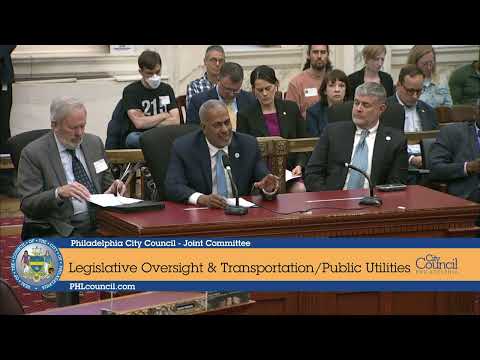
Philadelphia City Council on Monday convened a joint public hearing to investigate why residential energy bills in the region have risen and what government can do to blunt the impact on households.
The hearing, authorized by Resolution 2550896 and led by Chairs Thomas and Driscoll, brought elected officials, utility executives, grid managers and resident witnesses to City Hall for hours of testimony about supply, demand and potential local remedies. Council members said they wanted policy options they can act on in the months ahead.
State Representative Elizabeth Feedler, chair of the Pennsylvania House Energy Committee, told the committee that rising demand—driven by extreme weather, electrification and the expansion of data centers—has outpaced new supply, pushing prices higher. “When demand rises faster than supply, prices go up,” she said, and urged a combination of state reforms and cooperative regional action.
Feedler described a slate of state measures her committee has advanced: a Data Center Act (HB 1834) to give regulators authority over data center costs, bills to speed advanced transmission technologies (HB 2223), legislation to enable virtual power plants (HB 2264), and proposals to reform utility profit standards (HB 2224) and retail electricity protections (HB 2131).
Mayor Victor Karsten of Camden, New Jersey, told the council the problem is regional: Camden’s low-income and senior households face the same choice many Philadelphians do between heat and medicine. Karsten described Camden’s participation in a New Jersey Board of Public Utilities community solar program and said municipal participation and targeted enrollment should deliver discounts to qualifying customers.
Why it matters: Council members emphasized that while some drivers are regional or federal, the city has levers — from rate-case interventions to stronger weatherization and consumer protections — that can directly relieve households. Witnesses recommended expanded local programs, more aggressive enrollment in assistance programs, and coordinated pressure on state and federal regulators to speed new clean generation and transmission.
What’s next: Council members said this hearing is the first in a continuing series; staff and witnesses were asked to return with more detailed proposals, enrollment data for low-income programs and options for local regulation of data-center siting and local benefits.
(Reporting from the joint Committee on Legislative Oversight and the Committee on Transportation & Public Utilities.)