Get Full Government Meeting Transcripts, Videos, & Alerts Forever!
Get email alerts on the Commerce Bill Overview topic
No spam. Unsubscribe anytime.
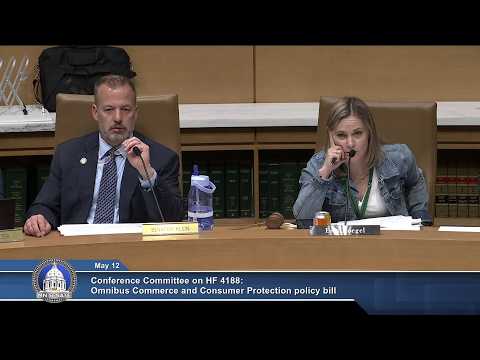
Conference committee reviews House–Senate differences on consumer protections, virtual currency and insurance
Summary
Nonpartisan staff walked conferees through House File 4188 side-by-side comparisons highlighting Senate-only provisions on virtual-currency kiosks, bank and credit-union crypto rules, mortgage and student-loan changes, a rental-home reimbursement guarantee, and insurance reforms; the committee heard advocates and the commerce commissioner before recessing.
Nonpartisan staff told the conference committee that the committee would work from a three-column side‑by‑side comparing House and Senate language for House File 4188 and related articles. The staff overview emphasized Senate-only provisions affecting financial services, consumer protections and insurance.
The Senate's consumer and financial services language would let financial-service providers communicate with a consumer's trusted contact with limited liability and add bank requirements for virtual‑currency services, including custodial segregation of assets. Senate-only text would also prohibit some virtual‑currency kiosks beginning Aug. 1, 2026, and make related technical changes to definitions and unclaimed‑property rules. "This section prohibits virtual currency kiosks beginning August 1st, 2026," the staff said, summarizing the draft.
Why it matters: the provisions would change how custodial activity and abandoned virtual assets are handled by financial institutions and the state’s unclaimed‑property framework. Staff noted the unclaimed‑property sections define when virtual currency is presumed abandoned and require liquidating and remitting proceeds to the commissioner.
The committee also reviewed insurance provisions in the Senate draft. Staff summarized a Senate section that would require insurers to accept Individual Taxpayer Identification Numbers rather than Social Security numbers for applicants and a set of mortgage‑servicing and originator standards carried in Article 7. Several sections address student‑loan servicers, including recordkeeping and borrower protections when loans transfer to a new servicer.
Industry testimony flagged travel insurance and lead‑generator language. Robin Rowan of Robin Rowan Associates, speaking for the Minnesota Insurance and Financial Services Council and the U.S. Travel Insurance Association, urged the committee to include the Senate travel‑insurance language and asked for a drafting change to refer to "insurance lead generator" in recordkeeping requirements so that existing insurers and agents are not unintentionally swept in. "On behalf of the U.S. Travel Insurance Association, we would urge the conference committee to include the Senate language on travel insurance," Rowan said.
The committee heard additional Senate‑only technical articles, including updates to weights‑and‑measures references, changes to the state's reinsurance program mechanics for 2027 reimbursements, and telecommunication statute cleanups and repeals.
Next steps: after the walkthrough, the committee called public testifiers and the Commerce commissioner for questions; members recessed to reconvene for public testimony later in the afternoon.