Get Full Government Meeting Transcripts, Videos, & Alerts Forever!
Get email alerts on the Enrtf 3426 Adoption topic
No spam. Unsubscribe anytime.
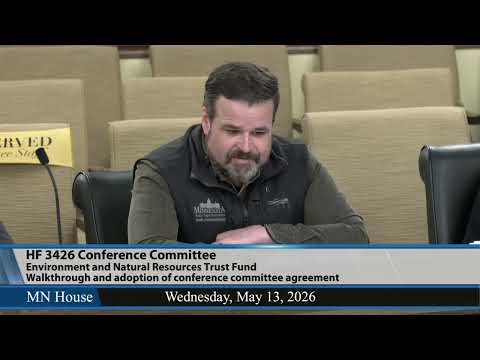
Conference committee adopts Environment and Natural Resources Trust Fund agreement, sparks objections over removed youth wilderness project
Summary
The conference committee approved a settlement of House and Senate positions on House File 3426 on May 13, 2026, adopting a package of appropriations and grant-administration policy changes while removing a proposed youth wilderness education project that drew objections from some senators.
The Environment and Natural Resources Trust Fund Conference Committee approved a conference report resolving differences between House and Senate positions on House File 3426 on May 13, 2026, adopting the D–E amendment and a spreadsheet dated 5/13/26 at 11:38 a.m. The committee voted 7–0 to approve the agreement and directed nonpartisan staff to prepare the official conference committee report and make technical conforming changes.
Nonpartisan fiscal staff summarized the agreement as largely harmonizing House and Senate positions. Greg Myre, nonpartisan staff, said the package includes multiple subdivisions (water, education and recreation, fish and wildlife, energy and land) and carries forward a set of projects and extensions. As read into the record, the draft appropriations total was stated in the meeting as approximately $102,036,000; this figure was described verbally during the fiscal overview and appears in the spreadsheet the committee adopted.
The agreement preserves a community grants appropriation the staff said matched both chambers and sets program-level guardrails. Staff explained the conference language establishes maximum grant amounts of $2 million for trail maintenance grants and $750,000 for other grants, with those maximums set to expire on June 30, 2028. The committee also adopted several administration and oversight provisions: annual DNR training for staff working on the community grants program in financial reconciliation and fraud prevention; in-person site visits for grants of $50,000 or more (and a required sample of smaller grants); removal of the word "random" from the sampling requirement as negotiated in the conference language; a requirement that grant recipients submit quarterly progress reports; and a requirement that advance payments be supported either by a surety bond or approval of a fiscal agent by the Minnesota Department of Natural Resources (DNR) when used.
Staff further noted Section 3.5 would require an affirmative vote of 12 commission members in order to recommend expenditures from the LCC emerging issues account, with procedures for conflicts of interest, and that Section 13 would repeal a prior requirement related to DNR-approved acquisitions funded with trust fund dollars.
The package also removes a single project that had been carried in one chamber but not the other. Senator Mike objected to the deletion of item 56, described in the draft as "cultivating conservation leaders through education wilderness experiences," calling the removal the result of "spurious accusations" and saying, "those kids will not be able to have those experiences ... to politicize something like this ... is a real shame." Representative Heintzeman replied that members must hold organizations to a high standard and that addressing concerns about projects was a bipartisan decision. Representative Fisher said the bill contained many positive elements despite his disappointment about the deleted project. Senator Her, joining by Zoom, spoke about personal connections to the Boundary Waters, expressed disappointment that the project did not survive the negotiations, but thanked colleagues and staff and said she supported the final agreement overall.
A member moved to adopt the D–E amendment and the spreadsheet and to empower nonpartisan staff to make technical and conforming changes; the motion carried on a roll call vote reported as seven ayes and zero nays. The committee concluded with acknowledgements to nonpartisan staff and researchers and adjourned, and members were asked to watch for an email to sign the conference report.
What happens next: nonpartisan staff will prepare the conference committee report and circulate it to members for signature; the conference report and the spreadsheet adopted by the committee represent the committee's negotiated text and direction to staff to finalize conforming edits.