Get Full Government Meeting Transcripts, Videos, & Alerts Forever!
Get email alerts on the Budget topic
No spam. Unsubscribe anytime.
Canyon Lake adopts FY 2026–27 budget after debate over public records workload and attorney hours
Summary
The council unanimously adopted the FY 2026–27 budget, including a $19,000 allocation to address an uptick in complex public records requests; a resident asked for itemized attorney billing tied to 27 requests, and the city attorney said legal review hours have surged.
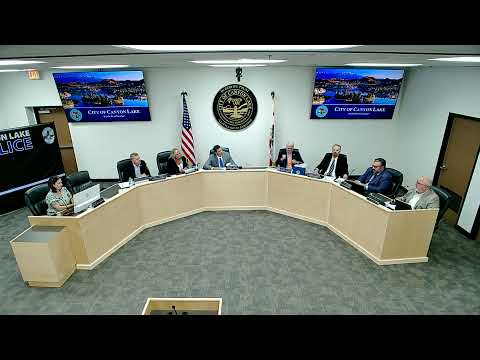
The Canyon Lake City Council unanimously adopted the fiscal year 2026–27 budget on May 20, 2026, after extended discussion about an increase in complex public records act (PRA) requests that staff say are driving legal and overtime expenses.
City staff recommended using roughly $19,000 in additional revenues to reduce the surplus to zero and cover the city’s response costs for an increase in non-routine PRA requests. The city attorney told the council that the city’s legal utilization on PRA responses has recently nearly doubled the 37 hours per month covered by the city’s retainer and that, “just this week alone we've received six new complex public records act requests.” He said complex requests often require legal review to determine whether documents are exempt from disclosure.
Resident and frequent requester Renee Griffith told the council she filed the 27 PRA requests listed on the agenda and questioned whether 87 attorney hours had legitimately been charged against those requests. She asked the council to obtain an itemized accounting of attorney time spent per request before adoption. "Accurate minutes and compliance with the Public Records Act are not discretionary," Griffith told the council, and she requested that prior minutes be corrected to reflect a text message read aloud at a March meeting.
Council members and staff emphasized transparency and the workload on a small-city staff. Several council members noted steps to make records more available online, urged requesters to consult the city clerk to scope requests, and praised staff for earning the Government Finance Officers Association (GFOA) Distinguished Budget Award for last year’s budget document. One council member said the city started the budget year with a roughly $600,000 structural gap that staff worked to close.
After discussion and public comment, the mayor moved to adopt the budget (including the staff-requested $19,000 allocation). The motion passed by unanimous roll-call vote.
Provenance: Discussion, public comments and the final roll call on adoption are recorded in transcript sections dealing with the budget presentation and subsequent public participation and council remarks.