Get Full Government Meeting Transcripts, Videos, & Alerts Forever!
Get email alerts on the Land Use Zoning topic
No spam. Unsubscribe anytime.
Citizens task force urges Laurens County to adopt a future land-use map and fund zoning study
Summary
A citizens task force presented findings from 15'16 countywide meetings and urged Laurens County Council to begin creating a future land-use map and budget $75,000—150,000 for professional help to design a zoning ordinance, recommending phased implementation and overlays as practical steps.
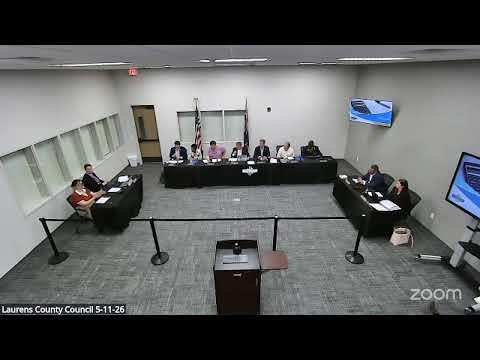
A citizens task force on land use told the Laurens County Council on May 11 that residents want protections from rapid, unregulated development and that the county lacks a future land-use map to guide consistent decisions.
"Laurens County's greatest treasure is our youth," the task force chairman said in opening remarks, describing 15 to 16 meetings and public-input sessions across council districts that drew more than 342 attendees and more than 210 participants. The presentation said the county currently has "no countywide zoning, no future land use map, and no consistent framework for growth decisions," creating uncertainty for residents and developers alike.
The task force laid out several implementation options: immediate county-council adoption of zoning, phased rollouts starting in areas under the most development pressure, overlay districts that target protections (for agriculture, watersheds or transportation corridors), or a referendum. The group emphasized the value of starting with a future land-use map and using outside professional planning assistance for ordinance drafting. "One option is county council adoption," the chairman said. "Another is phase implementation," and the group suggested overlays as a practical intermediate step.
Task force leaders recommended two immediate actions for the council: begin the process to create and adopt a future land-use map, and consider budgeting funds to hire a consultant to develop a zoning ordinance and public-engagement process. The presentation included a consultant estimate range of roughly $75,000 to $150,000, and the task force urged that budgeting such a study would not commit the county to countywide zoning but would provide technical analysis and community engagement.
Council members asked follow-up questions about costs, staffing and implementation approaches. One councilor noted the county has a special-projects fund that could be used for a one-time consultant fee; another emphasized that administrative staff and the county attorney could review the task force materials and return options to council rather than proceeding with immediate action.
Public commenters echoed the task force's concerns. Joseph Coler, a resident and HOA president of Oakville Estates, told the council that "decisions we make will outlive us" and urged smart development controls and a future land-use map to avoid mistakes seen in neighboring jurisdictions.
The council did not adopt zoning at the May 11 meeting. Instead, members asked county administration to review the task force's materials and prepare options and cost estimates for council consideration in the coming weeks. The task force made clear that its intent was to provide a roadmap and community input rather than a single mandatory prescription.