Get Full Government Meeting Transcripts, Videos, & Alerts Forever!
Get email alerts on the Neighborhood Traffic Calming topic
No spam. Unsubscribe anytime.
Ann Arbor City proposes revisions to neighborhood traffic calming program to boost accessibility and consistency
Summary
Ann Arbor City staff presented a plan to revise the neighborhood traffic calming program to better integrate it with the city's speed-management work, address accessibility on streets without sidewalks, and streamline retrofit implementation. Public engagement sessions are set for May 26 and June 3, 2026; staff expects to complete the revision by fall 2026.
Ann Arbor City staff on May 2026 outlined a plan to revise the city's neighborhood traffic calming program to improve how traffic calming tools are evaluated and implemented across neighborhood streets, with special attention to accessibility where sidewalks are absent.
The project team said the revision aims to align neighborhood traffic calming more closely with the city's broader speed management program, standardize evaluation and retrofit processes, and address accessibility concerns raised at recent neighborhood meetings. Staff noted the effort responds to city council resolution R-23-330, which directed a comprehensive review and update of the program timeline and approach.
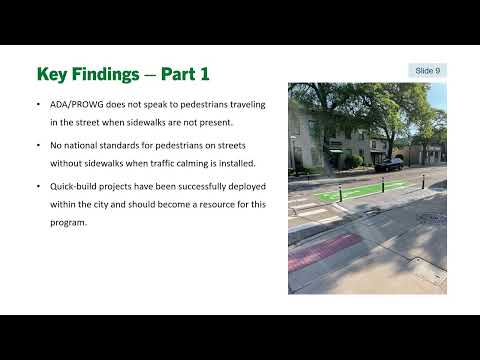
City staff said the review found that existing guidance, including the Americans with Disabilities Act and public right-of-way accessibility guidelines, does not explicitly address situations in which pedestrians must travel within the roadway on streets that lack sidewalks. The presentation also noted that no national standard currently exists for accommodating pedestrians on streets without sidewalks when traffic calming measures are installed, which can complicate local design decisions.
Key technical findings presented included: a need to better manage conflicts between traffic calming devices (such as speed humps, bumpouts and roundabouts) and accessible pedestrian routes; operational constraints including utility access and winter maintenance that affect device selection; and that speed humps and speed tables remain the most commonly requested and most easily implemented retrofit tools.
Staff said the revision will be coordinated with the city's sidewalk gap program. A new data-driven scoring matrix has been completed to help prioritize sidewalk improvements and ensure pedestrian infrastructure and traffic calming measures work together. The team identified several "quick build" pilot approaches that could be deployed to test designs before permanent installation.
Public engagement is scheduled for summer 2026. According to staff, community office hours will be held virtually on Tuesday, May 26 and Wednesday, June 3 to gather feedback and local experiences. The team anticipates completing the revised neighborhood traffic calming program in fall 2026.
"The goal of this project is to strengthen how the traffic calming measures are designed and implemented on neighborhood streets while ensuring accessibility, safety, and equitable mobility for all users," the presenter said. The presentation closed with a request that residents visit the city's project engagement page to submit feedback and stories.
Next steps: staff will use community feedback from the summer engagement phase to refine the draft program and bring recommendations back to the appropriate decision-making body later in 2026; specific dates and formal decision milestones were not specified in the presentation.