Get Full Government Meeting Transcripts, Videos, & Alerts Forever!
Get email alerts on the Homeless Shelter topic
No spam. Unsubscribe anytime.
Plan Commission forwards Safe Haven Hope Center shelter request after lengthy public hearing and adds oversight language
Summary
After extensive public testimony both supporting and opposing Safe Haven Hope Center’s request to operate a low‑barrier shelter at 315 S. Jefferson, the Plan Commission voted to forward the conditional-use permit to Common Council with six staff conditions and added language requiring 'qualified' documented complaints before a CUP review.
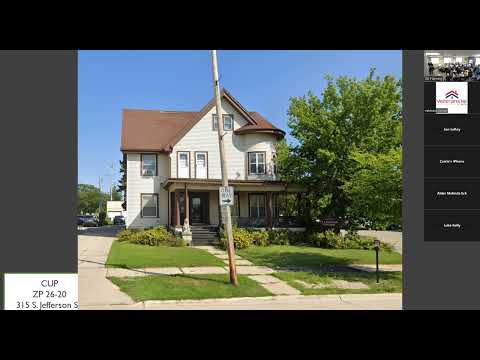
The Green Bay Plan Commission on May 11 voted to forward a conditional-use permit request from Safe Haven Hope Center to operate a peer-support shelter at 315 South Jefferson to the Common Council, after a lengthy public hearing that divided neighbors and community members.
City staff said the site had previously operated under a shelter CUP and a temporary use permit (issued April 3) that expires June 30, 2026. Staff reviewed an operating packet the applicant submitted—reported as more than 200 pages—and said the proposed facility would offer low‑barrier sheltering and peer support for adults experiencing homelessness. Staff noted the applicant’s intake procedures, a proposed minimum staffing ratio of one staff member per 10 residents, a declared prohibition on individuals listed on the Wisconsin sex-offender registry, and visitor hours limited to 8 a.m.–7 p.m. The building’s code-reviewed capacity remains 19 residents and a total occupancy of 26 people (residents, staff, volunteers and visitors), staff said.
The public hearing drew about two dozen people to speak. Supporters included volunteers, neighbors and people with lived experience of homelessness who described the shelter's work as life‑saving. Opponents, including nearby property owners, raised safety and enforcement concerns, cited a recent incident at a Motel 6 involving people connected to the organization, and questioned the organization's governance and financial recordkeeping.
A neighbor and property owner who identified himself as Eric, whose building is at 311 South Jefferson, criticized the low‑barrier model and said it would admit people with violent histories, drug addictions and mental-health issues "who are such behavioral issues that other tolerant shelters have kicked them out." He also cited the Motel 6 incident and warned that Safe Haven’s described approach to handling contraband—seizing and destroying drugs on site rather than contacting police—could risk violating criminal law.
Safe Haven’s representative Kathy responded to commissioners’ questions in the meeting. Kathy said the site blocks interior exits to prevent unauthorized overnight visitors and described staff monitoring: "No more people than what we have approved to be there and absolutely no alcohol or drug use on the property," she said, adding that staff conduct 30‑minute welfare checks when someone returns under the influence to ensure safety.
City staff recommended approval with six conditions including occupancy limits, operation in line with the submitted operating plan, maintenance of the neighbor grievance process, and compliance with municipal code. Commissioners debated the risk that repeated but unqualified complaints could be used to trigger CUP review; they agreed to add the qualifier "qualified" to the list of documented police calls or safety concerns that would prompt review. Vice Chair Jacob Miller moved to approve staff recommendations (with that change); the motion was seconded and the commission voted to forward the CUP to Common Council for consideration on May 19.
The plan commission’s action is a recommendation; the Common Council will make the final decision.