Get Full Government Meeting Transcripts, Videos, & Alerts Forever!
Get email alerts on the Calendar Conversion topic
No spam. Unsubscribe anytime.
Wake County staff present calendar‑conversion recommendations for several elementary and middle schools; board to consider May 19
Summary
Wake County Public Schools staff summarized public engagement and recommended calendar conversions for multiple year‑round schools, citing operational savings and concerns about extracurricular access; the board is scheduled to review final recommendations at a May 19 work session and may take action that evening.
Wake County Public Schools staff on May 13 presented final recommendations and community feedback on proposed calendar conversions affecting multiple elementary and middle schools, and told families the board will review final recommendations at a May 19 work session with an action item expected that evening.
Presenter Susan, representing the district’s long‑range planning and student‑assignment work, said staff compiled input from virtual information sessions and an online “thought exchange” that remained open through midnight on May 13. Staff reported that the outreach invited just under 9,000 students and families and logged 665 participants in live virtual sessions (299 live participants, plus additional views of recordings) and roughly 1,449 individual “thought exchange” posts across the district’s review areas.
Staff framed the proposals as tools to improve operational efficiency at underutilized, multi‑track year‑round schools while balancing family preference and equity. Susan said initial district estimates show elementary‑level conversions could save a “minimum of $90,000 a year per elementary school” in salary and allotment changes, and that middle‑school conversions could yield even greater staffing‑month reductions (presenter phrasing: “anywhere from 22½ to 35½ months of savings” depending on the site). She added that the district does not expect staff to lose positions as a result of calendar changes but acknowledged some 12‑month roles would shift to 10‑month assignments, changing pay timing for affected employees.
On program access, staff emphasized that converting middle schools to traditional calendars can improve students’ ability to participate in athletics and after‑school competitions because those programs generally follow a traditional schedule. Transportation impacts were described as likely nominal pending a more detailed analysis for the May 19 presentation; Susan said routes that currently carry siblings on shared runs would likely be maintained.
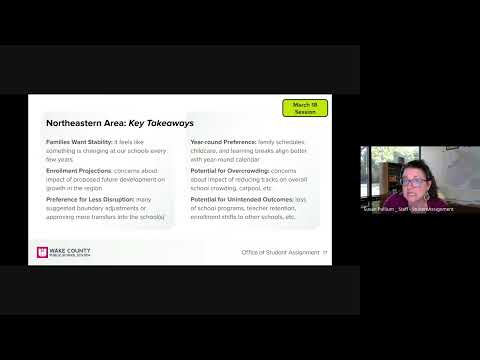
Staff also summarized community themes that emerged in geographic breakout sessions: strong support for year‑round calendars in many neighborhoods; concerns about enrollment projections and potential overcrowding if tracks are reduced; worries about destabilizing frequent calendar and boundary changes for families; and requests for clearer data on local residential development informing projections.
The district presented site‑specific recommendations and options for the Heritage campus, the Holly Grove/Holly Springs area and several northwestern schools (see separate articles for detailed proposals). Staff noted that Carpenter, Morrisville and Brier Creek were removed from consideration in this planning cycle because converting them now would create immediate overcrowding without boundary changes.
Next steps: staff will present a formal summary and recommended action to the Wake County Board of Education on May 19; the board may accept, modify or reject staff recommendations and is expected to take individual action on each school rather than treating the slate as a single item.