Get Full Government Meeting Transcripts, Videos, & Alerts Forever!
Get email alerts on the Digital Assets Regulation topic
No spam. Unsubscribe anytime.
Senate Banking Committee reports Digital Asset Market Clarity Act after contentious markup
Summary
After hours of debate and a string of roll‑call votes, the Senate Banking Committee voted to report HR 3633, the Digital Asset Market Clarity Act of 2025, to the full Senate, approving a manager's substitute and several bipartisan technical fixes while rejecting multiple Democratic amendments on investor protections and sanctions.
The Senate Banking Committee on a prolonged markup voted to report HR 3633, the Digital Asset Market Clarity Act of 2025, to the full Senate after adopting a manager's substitute and a package of bipartisan technical fixes. The committee recorded a roll‑call result reported in the transcript as 15 in favor and 9 opposed to order the bill reported as amended.
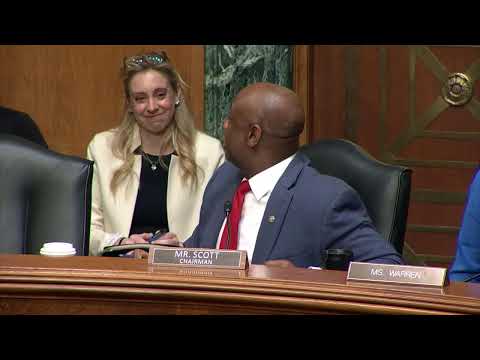
Chairman Scott framed the legislation as pursuing "three simple goals: protecting consumers, keeping innovation here at home, and safeguarding US national security," saying the bill brings digital assets "out of the shadows and into a system that is safer, fairer, and more transparent." Ranking Member Warren, who opened the Democratic critique, said the draft was "a bill written by the crypto industry for the crypto industry," argued it would erode investor protections and weaken law‑enforcement tools, and urged the committee to consider a wider set of amendments.
The session mixed procedural dispute and substantive debate. Committee staff explained several amendments were initially ruled out of order for drafting reasons; senators from both sides objected to selective exclusions and sought votes on fixes requested by law‑enforcement and community‑bank groups. The chair said some ruled‑out amendments were reintroduced to secure a bipartisan package.
Key roll‑call outcomes recorded in the markup included: - Adoption of the manager's substitute (Scott amendment #1) by voice vote, making that substitute the base text for further amendments. - Passage of Senator Rounds' amendment 133, creating AI innovation labs/sandboxes for regulated financial institutions to test AI projects, adopted 15–9. - Rejection of several Democratic amendments aimed at tightening investor protections, closing a tokenization loophole and restoring broader sanctions authority; multiple Warren amendments failed by 11–13 margins as recorded in the transcript. - Adoption of Senator McCormack's amendment 115 to adjust cross‑product portfolio margining rules and SIPA‑related protections, recorded as adopted 18–6. - A Reed amendment on dollar‑denominated stablecoin sanctions was rejected 11–13 after debate over whether the bill's titles already addressed illicit finance. - A series of Lumis amendments (122–126) that clarified the decentralization test, bank permissibility and rulemaking language were adopted in separate roll calls (recorded tallies in the transcript include 18–6 and 19–5 outcomes for those votes).
Supporters said the bill creates a predictable federal floor for digital‑asset markets, tightens anti‑money‑laundering reporting and disclosure rules, and integrates a framework for broker/dealer, exchange and kiosk activity. Senator Lumis and others described provisions requiring Treasury reports on offshore compliance, expanded BSA application to certain digital‑asset actors, and broker‑dealer disclosures as law‑enforcement and consumer protections.
Opponents focused on what they described as remaining gaps. Senator Warren and several Democrats said the bill would permit tokenized offerings to avoid securities laws, erode some state‑level consumer protections, and leave enforcement gaps that foreign adversaries and criminal groups could exploit. On the floor of the markup, she warned the bill "wipes out a huge number of state level protections against fraud." Other senators raised concerns about bank permissibility language and potential for increased leverage through portfolio margining.
The committee also debated ethics and conflict‑of‑interest language. Several Democrats urged enforceable guardrails to prevent elected officials, including the president and members of Congress, from profiting from digital‑asset deals; those amendments did not carry in committee.
With the committee's report, sponsors said they will continue negotiations before floor consideration — including negotiations with the Senate Agriculture Committee, which has parallel jurisdictional interests — and that staff will submit technical and conforming changes. Opponents urged further amendment opportunities, additional hearings and clearer law‑enforcement tools before final passage.
Next steps: HR 3633, as ordered reported, will be sent to the Senate calendar for further floor action. Committee members on both sides said they will continue discussions on outstanding concerns — including state enforcement, AML/sanctions authority and bank permissibility — as the bill moves toward consideration by the full Senate.