Get Full Government Meeting Transcripts, Videos, & Alerts Forever!
Get email alerts on the Fire Department topic
No spam. Unsubscribe anytime.
Fire chief urges doubling paramedic capacity, requests training officer and capital upgrades amid rising EMS demand
Summary
The fire chief told council that Bangor responded to about 11,000 calls and requested expanding paramedic staffing (eight positions total preferred, four currently funded), a training officer, and capital investments for stations, vehicles and equipment to address fatigue, training and delivery delays.
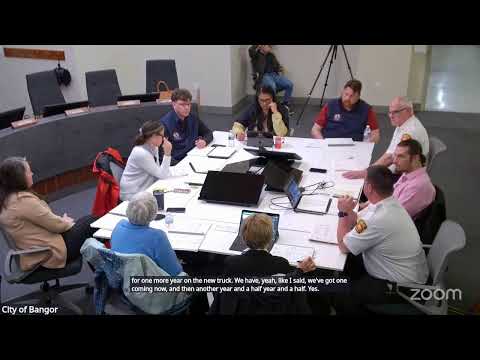
The fire chief presented the fire department’s FY27 budget priorities and urged the council to expand EMS capacity and training resources to address growing call volume and staff fatigue.
The chief said the department responded to roughly 11,000 calls in the last year and described a staffing shortage that pushes crews to run near or above acceptable utilization thresholds. “We responded to 11,000 calls,” he said, and added the city’s three ambulances run far more calls per truck than comparable cities. He said unit‑hour utilization and time‑on‑calls showed sustained pressure and that retaining institutional knowledge and reducing overtime requires adding staff.
The chief asked the council to consider eight paramedic positions as the correct staffing level to push utilization down to safer thresholds; four paramedics are funded in the base budget and the chief characterized eight as the necessary benchmark. He said an intermediate option (adding only four more) would provide some relief but not meet the city’s needs. To mitigate immediate risks, he said staff are implementing a fatigue management approach and advising crews to “slow down” when recovery time is needed between calls.
On training, the chief requested a full‑time training officer to centralize and administer the department’s training program, estimating up to $137,000 for salary and benefits to replace the current limited (20‑hour/week) arrangement and reduce overtime costs tied to in‑house probationary training.
Division Chief Jeremy Ogden, who spoke to EMS call categories, said the single biggest medical call type last year was a general “sick person” call (about 23–24%) and the second was false alarms (roughly 16%), and that the department has begun a trial EMS‑only ambulance with early evidence it is helping capacity.
The chief also discussed operational programs and capital needs: the community paramedic program (license application submitted and pending state approval), enforcement and limited collections under the lift‑assist ordinance (about $29,000 billed through March, with $7,100 collected), climate control upgrades for stations five and six, replacement or refurbishment of supervisor/administrative vehicles, and replacement of obsolete fit‑test equipment. He flagged long vendor delivery times for new apparatus as an ongoing procurement and schedule risk.
Councilors were direct: several said the staffing request is urgent and some pledged support, with one councilor saying they would not approve the overall budget without addressing firefighter staffing. No binding vote was taken; council asked staff to return with detailed budgetary tradeoffs and timelines.