Get Full Government Meeting Transcripts, Videos, & Alerts Forever!
Get email alerts on the Charitable Gambling topic
No spam. Unsubscribe anytime.
Charities, veterans and lawmakers press Minnesota Legislature to raise meat-raffle limits
Summary
Charity leaders and legislators held a Capitol event urging passage of HF 4090 and SF 4515 to raise per-ticket and prize caps for meat raffles (proposed: up to $5 tickets and $200 prizes), arguing the change would help local nonprofits, youth sports and veterans programs sustain fundraising.
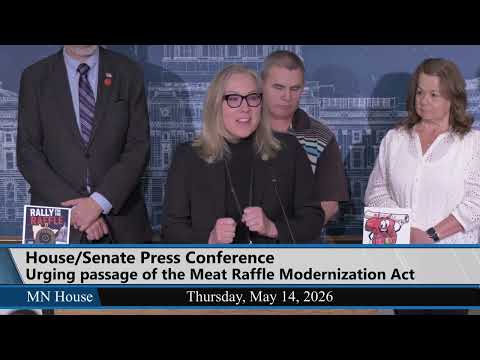
Representatives of charitable organizations, veterans groups and legislators gathered at the Minnesota State Capitol to urge lawmakers to pass HF 4090 and SF 4515, bills that would raise statutory limits on meat-raffle ticket prices and prize amounts.
Amanda Jackson, introduced herself as president of Allied Charities and a member of the Spring-like Park Lions, and told the gathering that meat raffles "are part of Minnesota's culture" and help veteran groups, fire relief associations and community nonprofits raise critical funds. Jackson said the current statutory limits — a $2 ticket and $70 prize cap set more than 30 years ago — have not kept pace with inflation and rising costs, reducing participation and fundraising revenue.
State Representative Jim Nash (District 48), a House author of the legislation, said the bill sailed through committee stops with broad support and that it is intended to preserve community fundraising rather than expand gambling. Nash said charities in Carver County alone raised about $1 million last calendar year and urged House leadership not to hold the bill for unrelated bargaining. "This is about building community," Nash said.
Tim Engstrom of American Legion Post 5.50 in Bloomington described meat raffles as a draw for customers that supports local bars, restaurants and veterans programs; he cited a $10,000 donation his post made to a high-school show choir as an example of the community benefit. Bob Adams, manager of a youth wrestling club, said there are roughly 1,100–1,200 similar youth organizations statewide that rely on event fundraising to cover tournament fees, equipment and scholarships.
Senator Judy See Burger said the measure has wide Senate support but had been left out of a recent conference committee report. She urged continued work to get the language included, and another speaker identified in the transcript as a senator emphasized that bipartisan procedural moves were underway to keep the bill viable in the near term.
Organizers demonstrated a mock meat raffle for attendees and answered questions about the bill's specifics. Participants described HF 4090 as expanding the allowable per-ticket charge up to $5 and raising the prize cap from $70 to $200 while leaving lower-priced tickets (such as $1 or $2) legal. Speakers said larger prize packages would restore the prize quality that drew participants in prior decades and help charities generate more revenue.
No formal vote or legislative action occurred at the event; speakers framed the effort as advocacy to encourage floor action and potential inclusion in a conference committee report. Organizers distributed mock raffle tickets and repeated their request that lawmakers move the bill forward so charities can continue raising funds for local programs.
The next procedural steps discussed at the event were seeking floor consideration in each chamber or working to place updated language in a conference committee report if both chambers do not pass identical language. The transcript does not record any formal motion, vote or change to law during the event.