Get Full Government Meeting Transcripts, Videos, & Alerts Forever!
Get email alerts on the Staff Budget Presentation topic
No spam. Unsubscribe anytime.
Pleasanton staff outline $8–10M two‑year reduction plan; library hours and grants among top targets
Summary
City staff presented a preliminary package of potential reductions to close a projected structural deficit, proposing tighter internal costs, library‑and‑recreation reductions (library hours, acquisitions budget), eliminated general‑fund nonprofit grants, and potential elimination of city‑funded crossing guards; staff recommended several major items (pool closure, closing a fire station) remain not recommended.
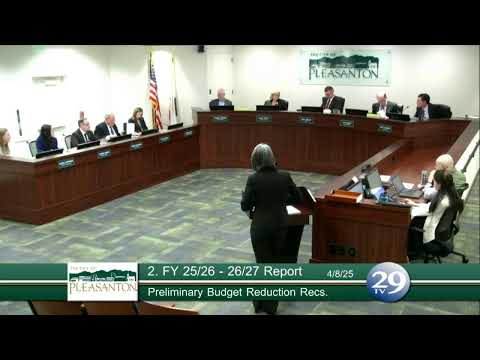
City Manager Bowden and finance staff presented a preliminary list of budget reduction options at the April 8 special council meeting, asking the council for directional feedback before staff drafts a balanced two‑year budget in May.
Finance Director Susan Sheay said the city faces an ongoing structural shortfall and presented an independent validation of the forecast by Ida Bailey. Staff described a list of 28 potential reductions that, combined with a previously authorized $2 million draw from the Section 115 pension trust, would move the two‑year plan toward balance. The presentation grouped reductions into categories: internal administrative savings, library and recreation, community support and human services, parks/streets/facilities, police and fire, and planning and building.
Key staff proposals highlighted:
• Library and recreation: reduce weekly library hours (options include closing one or two days per week), reduce the acquisitions/materials budget (staff described the “50%” number as a reduction to the acquisitions budget for the next two years, not removal of existing materials), combine library and recreation service desks, and restructure some recreation programs to improve cost recovery. Director Heidi Murphy said staff used usage heat maps to model options (for example preserving at least one weekend day) and offered to return with alternative schedules (a six‑day model, one‑day closure) on April 10.
• Community support and grants: staff proposed eliminating the general‑fund portion of the housing and human‑services grant program (the program also draws on CDBG, HOME and other restricted funding streams) and suspending youth and civic arts grants; staff offered the option of a different grant model (an RFQ with fewer, larger awards) as an alternative.
• Crossing guards: staff proposed eliminating funding for the city‑contracted crossing‑guard program that serves 22 locations (current annual cost shown as roughly $650k with escalation to about $750k in year two). Traffic Engineer Mike Tasano presented usage and vehicle‑count data and noted alternate models exist in other cities and cost‑sharing with the school district is an option.
• Parks and facilities: proposed reductions to park and trail maintenance contracts, janitorial frequency and median landscaping to achieve several hundred thousand dollars in savings, with the caveat that the appearance and level of maintenance would decline.
Staff flagged several high‑value items that they did not recommend cutting at this time, including closure of the Dolores Bankston Aquatic Center and closure of a fire station, because of service and life‑safety impacts. Staff also stressed the city faces significant capital needs identified in an asset list and urged council to weigh operating cuts against long‑term capital funding (CIP) decisions.
Staff asked the council for directional 'yes/maybe/no' feedback and offered to return on April 10 with refined numbers and alternatives; the council did a straw poll on many items and directed staff to bring supplemental materials.