Get Full Government Meeting Transcripts, Videos, & Alerts Forever!
Get email alerts on the Housing topic
No spam. Unsubscribe anytime.
Palm Coast council prioritizes infrastructure after housing study
Summary
Council reviewed a new housing needs assessment and heard strong public interest in a concrete skate park, then directed staff to prioritize infrastructure and maintenance — including stormwater and pavement — while pursuing grants and options to fund long‑term repairs.
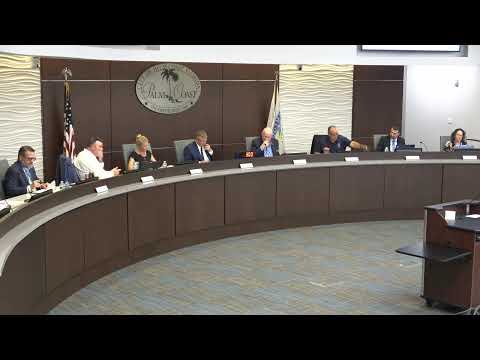
Palm Coast City Council drew a packed room and pointed direction to staff on May 12 after a presentation of a housing needs assessment that linked rising demand to gaps in infrastructure. The council agreed to pursue multiple steps — from faster stormwater maintenance to new spending scenarios for road resurfacing — and asked staff to return with funding options and implementation plans.
The assessment, presented by Tara Howell of consultant JB Pro, concluded that Palm Coast’s housing inventory is heavily weighted toward single‑family homes and that affordability challenges are growing for households earning below 80% of Area Median Income. "This report provides a data‑driven evaluation of the city's current housing conditions," Howell said during the presentation, urging a mix of zoning changes, permitting reforms and partnerships to expand attainable housing options.
Why it matters: Council members and residents framed the housing findings as a moment to connect land‑use choices to infrastructure and quality of life. Multiple speakers pressed for targeted solutions for older residents and public‑sector workers who cannot find local housing they can afford. "This is about accountability, transparency, and long‑term planning," public participant Jeremy Davis told the council during public comment, arguing that residents need clearer enforcement of technical standards.
What the council directed: After extended Q&A and public comment, council members asked staff to develop concrete funding scenarios for pavement and stormwater programs, to continue pursuing grants and to return a final set of Strategic Action Plan priorities on June 2. Staff were given explicit go‑ahead to: (a) accelerate a pontoon excavator purchase to support canal work, (b) finalize an HMO option for employee health plans while grandfathering existing PPO members, and (c) prepare detailed pavement‑funding options that balance arterial and collector needs.
Key details reported to council - Housing queue: staff and the consultant reported roughly 6,200 multifamily units currently in the development queue and an assisted housing inventory of about 616 units. - Stormwater progress: Lynn Stevens, deputy director of stormwater, said new trenching crews and vacuum trucks cut the backlog of swale work orders from more than 1,000 to about 341 and that staff expect to "exceed our goal of 60 miles this year" of swale improvements. - Pavement condition: a Transmap scan presented by Carl Cody showed the citywide pavement condition index (PCI) declined since 2017; residential collectors in particular risk steep drops unless funding is increased. Staff were asked to deliver funding scenarios showing tradeoffs between focusing on arterials vs. collectors.
Representative quotes - "This report provides a data‑driven evaluation of the city's current housing conditions," said Tara Howell, JB Pro senior planner. (Presentation) - "This is about accountability, transparency, and long‑term planning," said resident Jeremy Davis during public comment. (Public comments) - "We will exceed our goal of 60 miles this year," Lynn Stevens said of recent swale and trenching gains. (Stormwater update)
Other directions and items of note - Housing strategies: Council favored targeted approaches (senior housing, ADU policy changes, expedited permitting), not broad unfunded mandates. Staff should return with specific code or incentive proposals tied to the assessment’s recommendations. - Duplex‑lot options: Staff outlined proposals to split certain duplex‑zoned lots; council asked staff to continue study but expressed concern about neighborhood compatibility and one‑off pilot programs. - Health insurance: Council agreed to offer an enhanced HMO and retain the HDHP (HSA) while allowing current PPO members to stay on that plan; staff scheduled an October implementation. - Stormwater equipment: Council gave consensus to accelerate purchase of a pontoon excavator (funding to be included on the next business agenda) to speed canal dredging and address high spots earlier in the dry season. - Pavement funding: Staff will prepare written scenarios showing what different revenue amounts (and sources) would do to PCI for arterials, collectors and local roads; council asked staff to show combinations that include a modest transfer of general‑fund money already being used for micro‑surfacing and more structural options such as a dedicated millage or other local revenue tools. - Strategic priorities: Staff presented draft Strategic Action Plan priorities based on resident surveys and council input. Council refined the list and asked staff to return a revised SAP for adoption on June 2.
Next steps: Council requested staff return with: detailed pavement funding scenarios and options; a refined set of SAP priorities for adoption June 2; a proposed ordinance for the charter amendments discussed at workshop; a feasibility and funding plan for stormwater/canal dredging (including grant pursuits); and a short memo on grant‑writer options and next steps for pursuing federal/state infrastructure grants. The city also accepted staff's plan to keep developing operational improvements—such as swale and culvert work scheduling and proactive maintenance—while pausing on any immediate new, voter‑facing revenue items until the June truth‑in‑millage information is available.
The council adjourned after final business and set follow‑up items to return to future meetings.