Get Full Government Meeting Transcripts, Videos, & Alerts Forever!
Get email alerts on the House Bill 45 topic
No spam. Unsubscribe anytime.
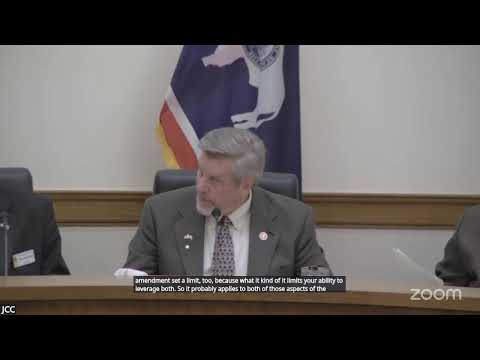
Joint conference committee concurs on House Bill 45 amendment to clarify long-term homeowner exemption
Summary
A joint conference committee voted to concur on changes to the long-term homeowner property-tax exemption in House Bill 45, removing the sunset, switching valuation language to fair market value, adding a $3 million cap and adding language to prevent owners from claiming that exemption and a separate people's initiative simultaneously.
A joint conference committee on House Bill 45 voted to concur on an amendment that clarifies and limits the state's long-term homeowner property-tax exemption.
The amendment removes the exemption's sunset, makes procedural changes including a March 1 reporting date, replaces assessed-value language with fair market value, sets a $3 million cap on eligible property, and adds a provision intended to prevent an owner from claiming both the long-term homeowner exemption and a later people's initiative exemption.
"All this does is make sure that if you choose the long-term homeowner, you don't get the people's initiative exemption," the member proposing the amendment said, describing the change as a tidy clarification to prevent double-dipping if voters enact an overlapping initiative. The sponsor said the amendment also deletes two Senate-inserted provisions that created confusion about stacking.
Committee members discussed whether the amendment should say an owner "shall not qualify" for the initiative exemption or use a repeal trigger. The sponsor explained repeal language was removed to avoid creating a trigger bill that could prompt constitutional challenges if the initiative fails. The sponsor said the committee can revisit that precise wording during the interim if needed.
Members also addressed valuation and the new cap. One member said the language was changed from "assessed value" to "market value" and a $3 million cap was included; he and others said assessors advised that using fair market value simplifies administration without changing the underlying tax amounts. The sponsor confirmed the cap was intended to limit the size of the exemption and noted the catch title language referencing a limitation was meant to cover both the cap and the anti-stacking provision.
The transcript records a roll-call concurrence vote; six members voted in the affirmative. Names recorded in the roll call included Representative Lockach (recorded later as Representative Lock), Representative Sherwood, Representative Stybar, Senator Mchuan (appearing in the roll call as Mchuan/Macau), and Senator Pearson; one senator's recorded vote in the transcript appears without a clear name. The chair announced there was concurrence and the committee adjourned.
The amendment directs the Secretary of State to certify initiative results to the Department of Revenue for the anti-stacking provision to take effect if a people's initiative is enacted into law; the transcript mentions that certification step in the proposed language but does not cite a specific statute. The transcript does not specify implementation details such as effective dates beyond the statement that concurrence would remove the current sunset date of July 1, 2027.
Next steps: the committee recorded concurrence and adjourned; the transcript indicates paperwork was completed but does not record further legislative scheduling or final enactment dates.