Get Full Government Meeting Transcripts, Videos, & Alerts Forever!
Get email alerts on the Parking Management topic
No spam. Unsubscribe anytime.
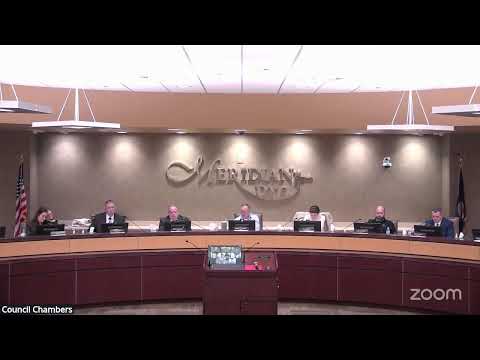
Consultants, council, business group discuss parking plan for downtown Meridian
Summary
Consultants presented near‑term parking management recommendations for Meridian’s downtown, urging clearer signage, defined management boundaries, and a standing stakeholder subcommittee. Council asked for coordination, funding clarity and enforcement plans before moving to costlier options.
A consultant team briefing on downtown parking kicked off Meridian’s Feb. 24 work session, with staff and council members exploring how to turn data from a recent inventory into tighter parking management and clearer guidance for residents and visitors.
Chris Danley reopened the Destination Downtown subgroup’s parking work and said the inventory — collected on foot at peak periods — showed significant unused capacity across the study area, with local block‑face peaks at certain times. ‘‘There is lots of available parking,’’ Danley said, while flagging hot spots that need management.
Owen Ron Kelly of Rick Williams Consulting, who led data collection and stakeholder outreach, said the plan focuses on low‑cost, near‑term actions rather than expensive fixes such as garages or metering. Near‑term recommendations the team emphasized include formalizing guiding principles, defining a parking management district boundary, setting inter‑agency protocols for signage/striping decisions and convening a standing parking subcommittee of downtown stakeholders.
‘‘Parking management is on a big arc,’’ Kelly said. ‘‘You don’t have a parking problem today, but there are areas of constraint at key times and you should be cognizant of what’s coming down the pike.’’ He urged the city to focus first on organization, consistent signage, a public information website and operational measures like time limits and targeted enforcement.
Council members pressed for specifics on cadence, roles and costs. Councilman Taylor asked how often a subcommittee should meet; Kelly recommended starting with two to three times a year and increasing frequency while implementing strategies and collecting follow‑up data. Councilman Overton said any long‑term plan must address enforcement staffing: ‘‘We need to make sure we don’t put signs up and then disappoint residents because we don’t have the manpower to enforce them consistently.’’
Ashley, representing MDC, told the council the downtown development organization has historically led branding, signage and website efforts and is prepared to be an active partner. ‘‘We have taken that on to relieve staff, but it needs a board conversation,’’ she said.
The consultants also outlined a public‑facing web and signage effort to telegraph priorities for on‑ and off‑street parking — ‘‘what we hope you will find convenient and where to go,’’ Kelly said. Council members generally supported near‑term, lower‑cost measures but asked staff to return with clearer estimates of one‑time and ongoing costs, suggested lead agencies for each action and options to fund additional enforcement if the program grows.
What’s next: staff will take council direction to coordinate a subcommittee structure and clarify funding and enforcement options. The consultants recommended staged implementation — near‑term operational fixes, then short‑ and intermediate measures if occupancy thresholds indicate the need to expand strategies.