Get Full Government Meeting Transcripts, Videos, & Alerts Forever!
Get email alerts on the Parking Abandoned Vehicles topic
No spam. Unsubscribe anytime.
Wilsonville staff to pursue code changes to speed removal of abandoned vehicles; RV permit pilot deferred pending results and funding
Summary
Council directed staff to pursue code updates that would reduce public‑street standard parking limits to 48 hours and expand the abandoned‑vehicle definition to allow 24‑hour tow triggers under certain conditions; the RV parking‑permit program remains a possible later step after evaluation of code changes and funding for enforcement.
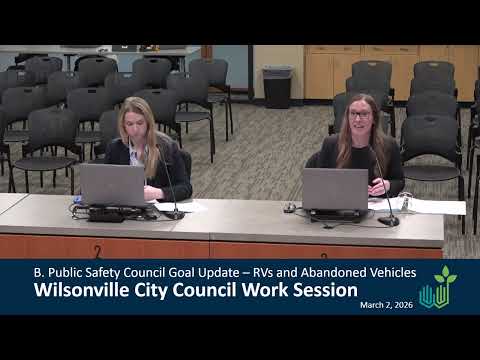
City Attorney Amanda Guy Henman presented draft code updates that would give code enforcement and law enforcement more discretion to declare vehicles abandoned and would shorten some timeframes for action.
Henman outlined two primary proposals: shortening the standard public‑right‑of‑way parking time limit from 72 hours to 48 hours, and revising the abandoned‑vehicle definition so that a vehicle parked on the public right‑of‑way for 24 hours could be deemed abandoned if it also meets qualifying conditions (for example, expired registration or lack of insurance). "Right now the way our abandoned vehicle definition is worded ... it talks about that a vehicle must be inoperable or wrecked, dismantled, junked," Henman said, adding the proposed language would give enforcement staff clearer authority to make operability determinations.
Councilors pressed staff on practical questions: whether moving a vehicle a short distance restarts the clock (staff said it does not as long as it remains on the right‑of‑way), whether to apply rules to private parking (staff said the code changes apply only to public right‑of‑way), and whether shortened rules would create enforcement delays because officers must observe conditions. Henman noted Oregon law generally requires a 24‑hour notice before a tow.
On RV parking, staff described an optional permit program modeled on regional examples: a free 72‑hour permit, caps on days within a rolling period, and an annual paid residential pass option. Staff recommended a three‑year pilot with reports at six months and annually to assess efficacy. Council members raised the cost and logistics of towing RVs: staff said RV tows can be far more expensive and harder to procure than standard vehicle tows—citing hazardous waste disposal, storage and special handling—and estimated average RV tow costs in the thousands (staff cited figures in the $7,000–$10,000 range and described roughly $10,000 as a typical RV tow cost), while ordinary auto tows are typically in the hundreds.
Given enforcement cost uncertainty, staffing constraints and the potential need for contracted tow services, staff recommended pursuing code updates first and assessing whether those changes sufficiently address community complaints before launching a new RV‑permit program. Several councilors supported that staged approach.
Staff said if council wants to proceed with the full set of changes (abandoned‑vehicle definition, reduced parking limits and any RV program), a separate funding discussion will be needed because enforcement and towing costs are not currently budgeted.