Get Full Government Meeting Transcripts, Videos, & Alerts Forever!
Get email alerts on the Driveway Code Reform topic
No spam. Unsubscribe anytime.
Rybrook trustees pause enforcement of driveway-violation notices after Maywood residents object; board to propose code changes
Summary
After Maywood Avenue residents protested notices citing a 1961 driveway setback, the Rybrook Board of Trustees agreed May 12 to pause enforcement and direct staff and counsel to draft code revisions (including possible amnesty, survey requirements and lot-size rules) before taking further action.
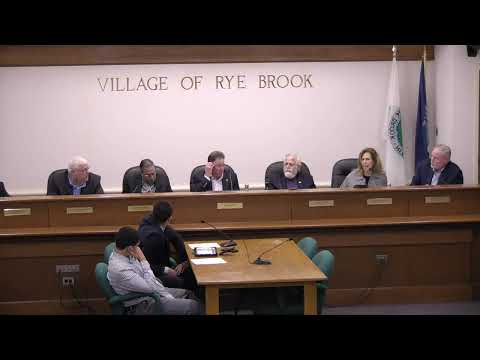
The Village of Rybrook Board of Trustees on May 12 temporarily paused enforcement of driveway-extension violation notices and directed village staff and its counsel to draft legislative options after residents—chiefly from Maywood Avenue—said they were surprised and alarmed by the notices.
Administrator Chris told the board the issue surfaced when a title-search tied to a recent sale flagged an expanded driveway that required relief from the zoning board of appeals. Chris said village code bars driveway expansions within the first 25 feet of a property without a permit and that any expansion exceeding 400 square feet triggers stormwater mitigation requirements. He told the meeting the evening’s discussion was only to consider policy options, "not action as proposed tonight."
Why it matters: residents said many driveway extensions predate modern zoning and were never enforced, while the village said it must follow code when a potential violation is reported. The dispute highlighted how a single enforcement trigger at time of sale can disrupt closings and generate hardship.
Residents from Maywood Avenue said their driveways had existed for decades and asked to be grandfathered or treated under an amnesty program. "I received a letter in the mail that told me I had 30 days to comply or be fined up to $1,000 a day and imprisonment," said resident Laurian Odanu, who described narrow lots and preexisting nonconforming conditions that make strict compliance impractical. Several neighbors said curb-cut changes and small lot sizes make the 25-foot setback and other dimensions impossible without major demolition or expense.
Trustees and staff described possible remedies that could be drafted into legislation: (1) a targeted amnesty or fee waiver for long-standing, pre-2005 conditions supported by dated surveys; (2) allowing lesser documentation (a sketch plan with measured dimensions) in some cases instead of a new full survey; (3) tying allowable driveway width to lot width or zoning subdistrict; and (4) transferring some review discretion from the Zoning Board of Appeals to the Architecture Review Board or to the building inspector under tightly defined parameters.
Trustee Crom urged flexibility for longtime residents while emphasizing fairness: he suggested standards keyed to when an expansion occurred and whether a certified survey exists. Trustee Morino favored parameters that would allow inspection-based approvals where a survey or historical documentation shows a preexisting condition.
The board also addressed the tone and process that triggered public ire. Mayor Klein responded to residents who said enforcement was selective by saying, "I can assure you that this was not targeted," and agreed the village should improve communications about enforcement pauses and next steps. Chris clarified the standard violation-notice wording is required by law and that the 30-day cure period is a state rule; he said building department staff have been instructed not to pursue court actions while the board considers policy changes.
Next steps: the board directed staff and counsel (Keenan Bean) to draft proposed code changes and parameters for relief or amnesty; that draft will be posted publicly and must be noticed for a public hearing before any change is adopted. Board members warned the legislative and public-hearing process could take several months. The board also agreed to notify residents who received violation letters that enforcement is paused while code revisions are considered.
The board did not adopt any ordinance or formal amnesty at the May 12 meeting; rather, it authorized staff to prepare draft legislation and policy options for future board consideration.