Get Full Government Meeting Transcripts, Videos, & Alerts Forever!
Get email alerts on the Health Care Access topic
No spam. Unsubscribe anytime.
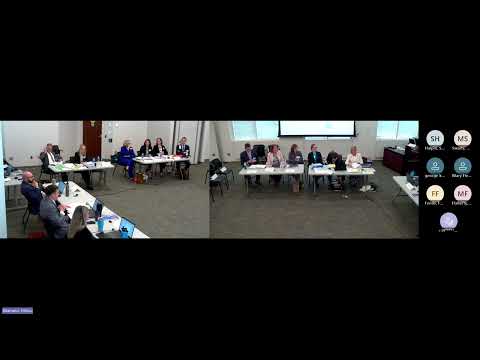
Hearing on Encompass Health’s Branford rehabilitation hospital probes need, staffing and local impact
Summary
At an Office of Health Strategy hearing, Encompass Health defended its proposal for a Branford inpatient rehabilitation hospital, citing regional demand; regulators and local providers pressed the applicant on Connecticut‑specific outcome data, service‑area methods, staffing and potential effects on nearby hospitals and training programs.
Encompass Health defended its proposal to open an inpatient rehabilitation hospital near Branford at a public hearing before the Office of Health Strategy, while municipal supporters and local providers pressed the applicant for Connecticut‑specific evidence on patient outcomes, service‑area methodology and staffing impacts.
The hearing opened with a public comment from Perry Moresca, economic and business development manager for the town of Branford, who said the shoreline region has seen population growth and "a definite need" for closer post‑acute rehabilitation services so families can visit patients without long drives. Moresca said physicians and elected officials in the Greater New Haven area have submitted letters supporting the project.
Why it matters: regulators must determine whether the proposed facility would meet an unmet clinical need without unfairly harming existing providers, whether staffing and quality safeguards are sufficient, and whether the applicant’s travel‑time and utilization analyses accurately reflect Connecticut patient flows.
Key points from the hearing
- Corporate structure: Regulators asked whether Encompass’s home‑health and hospice business, said in filings to have been spun off to a new company called Abid, remains governed or controlled by the same ownership. "To my knowledge, no," an Encompass representative said when asked whether there is governance overlap, and counsel later affirmed that past private‑equity affiliations cited in other states reflected acquisitions rather than current control of the proposed Branford facility.
- Need and outcomes: OHS examiners pressed the applicant on the evidence tying Connecticut’s lower inpatient rehabilitation facility (IRF) utilization to measurable harms. "I do not know enough about the US News ranking and their criteria to address that," the Encompass witness responded when asked to link a national quality ranking to post‑acute access. Panelists repeatedly noted limits in available Connecticut‑specific outcome and readmission metrics and asked the applicant for state‑limited analyses and zip‑code breakdowns of Danbury (Danbury) admissions.
- Service‑area methodology: Encompass described using Google Maps travel times, local consultation and population 65+ counts to define the patient service area (PSA) and acknowledged the process included judgment calls. The applicant said it did not prepare a single written ‘‘work paper’’ with fixed radii but relied on travel‑time, roadway patterns and conversations with Connecticut practitioners to refine boundaries such as the cut line at West Haven rather than Milford.
- Quality and clinical tools: Encompass said its hospitals use a Cerner/Oracle electronic medical record and that clinicians have access to referring hospitals’ Epic records. The applicant described deploying algorithmic tools, including a readmission‑prediction workflow and a telehealth hospitalist follow‑up pilot; the witness reported a 45% reduction in readmissions for patients seen through that telehealth intervention compared with those who were not.
- Staffing and recruitment: Company witnesses said they typically run about 5.9–6.2 nursing care hours per patient day across facilities and described recruitment measures—tuition reimbursement, clinical ladders and student pipelines—to grow staff without relying on contract labor. Intervenors asked for salary ranges, recruitment‑source data and evidence that new hires will expand the workforce rather than shift staff from existing providers.
- Competitive and programmatic impacts: Representatives from area rehabilitation programs raised concerns that a new IRF could draw referrals and residents from existing programs and training rotations; Gaylord and other providers said they had experienced small but material referral shifts after IRF openings elsewhere and flagged possible effects on residency case volumes and accreditation thresholds.
Quotes that capture the hearing tone
- "There is a definite need and a desire to have such a beneficial facility in this area," Perry Moresca, economic and business development manager for the town of Branford, said in public comment.
- "I do not know enough about the US News ranking and their criteria to address that," said the applicant’s clinical witness when asked whether a national ranking implies Connecticut’s substitution patterns are safe for patients.
- On data limits and pilot results, an Encompass representative said: "We've seen a 45% reduction in readmission for the patients that they're seeing compared to patients that they don't see," describing a telehealth follow‑up program.
Outstanding requests and next steps
Regulators and intervenors asked Encompass for additional, Connecticut‑specific evidence, including zip‑code analyses of Danbury admissions limited to Connecticut residents, documentation of PSA inclusion/exclusion rules, salary ranges for rehabilitation clinicians, and some late‑filed materials the applicant said it could provide. The hearing officer said the office would issue an order about timing for late filings; the panel recessed to organize late submissions and scheduled brief closing arguments.
What was not decided: The hearing recorded extensive questioning and oral testimony but no final action, motion or vote on the application during the session.
Sources and attribution: Article is based exclusively on testimony and exchanges recorded in the Office of Health Strategy hearing transcript for the Encompass Health Branford application. Where speakers did not give a full name or title in the record, the article uses the role label recorded in the transcript.
Next procedural step: The hearing officer indicated the office will issue an order on late filings and will accept the additional material for the record before issuing further procedural directions.