Get Full Government Meeting Transcripts, Videos, & Alerts Forever!
Get email alerts on the Blue Envelope topic
No spam. Unsubscribe anytime.
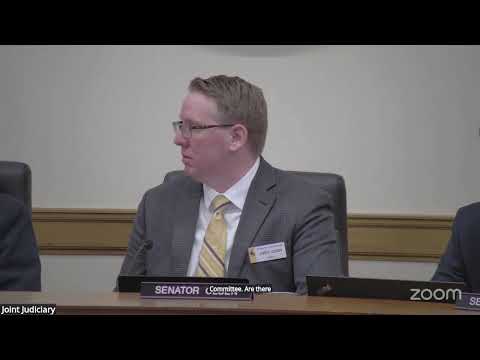
Debate at Judiciary panel over statewide "Blue Envelope" program to signal neurodivergent occupants
Summary
Lawmakers heard proponents and law-enforcement officials weigh a voluntary "Blue Envelope" program to alert first responders that a vehicle contains someone with communication or sensory needs; WyDOT and several sheriff's offices said a statewide awareness rollout via DMV is feasible but cautioned against mandates.
Representatives of families, law enforcement and the Wyoming Department of Transportation spent the afternoon debating a voluntary "Blue Envelope" program designed to give first responders a simple visual cue — an envelope or decal kept with the driver's paperwork — indicating that an occupant may have autism or other communication needs.
Representative Alisa Campbell introduced the program and said it began after a constituent raised concerns about drivers or passengers who experience sensory overload or difficulty speaking during traffic stops. Sarah Riley, whose daughter is autistic, told lawmakers the envelope would let officers know to slow down and use de-escalation techniques.
"I want her to have a good and safe experience," Riley said, explaining she wants a simple, discreet way for her daughter to indicate she needs more time or different communication methods during a stop.
Misty Zimmerman, program manager for Wyoming Driver Services, said the state already allows limited medical-condition indicators on licenses through a 2019 statute ("Cody's Law"), and that DMV could distribute envelopes at driver-service locations if the Legislature directed it. Law enforcement testimony came from Lt. Rich Ko (Sweetwater County), Sheriff Clint Becker (Converse County) and Lt. Col. Carl Germaine (Wyoming Highway Patrol). Sheriff Becker said Converse County implemented the envelope at local expense and reported positive public response; Lt. Ko emphasized the program could protect both residents and officers by lowering the chance that a person in crisis will be misread as noncompliant.
Some committee members expressed concerns about possible spoofing (people using the envelope without need), targeting (bad actors observing decals), or unforeseen liabilities for officers. Law-enforcement leaders recommended a voluntary statewide awareness program distributed through DMV and emphasized continued de-escalation training. Several suggested limiting the program to a single, standardized item distributed at driver-service centers to avoid confusion across jurisdictions.
The committee debated two draft approaches: one to direct WyDOT to administer a statewide voluntary program and provide materials, and a narrower nonbinding motion to produce a standardized envelope that local agencies could distribute without state funding. The broader motion failed on a divided voice/hand vote; the committee later approved a narrower, non-codified request to have LSO prepare a standard envelope template available to counties and municipalities (no state mandate or appropriation required).