Get Full Government Meeting Transcripts, Videos, & Alerts Forever!
Get email alerts on the Behavioral Health topic
No spam. Unsubscribe anytime.
Mental Health Recovery Services shares FY2025 report; plans five-county consolidation
Summary
Mia Handrew presented Mental Health Recovery Services' fiscal 2025 annual report to the Seneca County commissioners, detailing mobile crisis response data, suicide and overdose figures, and a planned July 1 consolidation into a five-county behavioral health district under a new name.
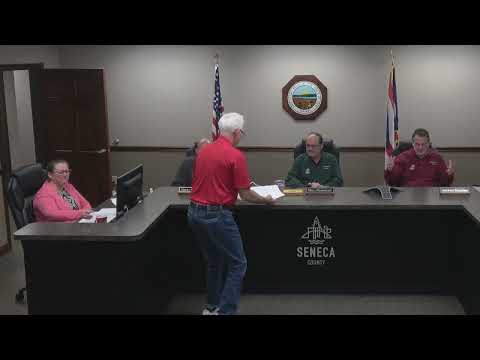
Mia Handrew, representing Mental Health Recovery Services, presented the group’s fiscal 2025 annual report to the Seneca County Board of Commissioners on March 3, highlighting service-level financial detail, crisis response outcomes and plans to consolidate with neighboring counties.
Handrew said the annual report breaks out every capital facility, outcomes for every facility and rent collected by resident, allowing commissioners to see per-project spending and client outcomes. “We released the fiscal year 2025 annual report,” Handrew said, and noted the booklet was provided in the commissioners’ packet.
Handrew described the agency’s mobile crisis response team as a two-person unit that operates daily from 8 a.m. to 11 p.m. in Seneca County and responds to mental-health crisis calls wherever they occur — at private homes, parks or businesses. She reported the team hospitalized 116 individuals last year through its responses; roughly 20% of those hospitalizations were involuntary. She also said law enforcement was involved in about 4% of calls and that 93% of incidents did not result in arrest.
The presentation included fatality and overdose statistics for calendar 2024. Handrew said Seneca County’s suicide rate was 16.3 per 100,000 people for that year and that males accounted for about two‑thirds of suicides. She said the most represented age group was 19–34 and that 60% of suicides were by gunshot and 26% by hanging. Overdose deaths were highest in the 35–50 age group, which Handrew said were primarily fentanyl-related.
Handrew announced a planned consolidation, saying the organization will merge with a neighboring county and form a five‑county board district effective July 1 and will adopt the name North Central Behavior Health Board. She described the move as an effort to reduce administrative costs, expand cross‑county collaboration and sustain programs in the rural region.
The agency also publicized a March 31 suicide prevention and education event in Seneca County featuring the Ohio Suicide Prevention Foundation CEO and NAMI Ohio, and said two young people with lived experience will speak about recovery.
Why this matters: the report gives commissioners facility-level transparency on spending and outcomes, quantifies demand for mobile crisis services and identifies suicide and overdose trends the county may factor into prevention and treatment planning.
The board thanked Handrew for the report and asked clarifying questions about regional similarities and the planned consolidation. Handrew said the consolidation will allow partner counties to share providers and sustain services that are difficult to finance from a single county budget.
The presentation did not include a formal vote. Commissioners indicated support and requested continued updates as consolidation details and implementation plans are finalized.