Get Full Government Meeting Transcripts, Videos, & Alerts Forever!
Get email alerts on the School Budget topic
No spam. Unsubscribe anytime.
Sun Prairie Area School District projects $3.7 million shortfall in proposed 2024–25 budget
Summary
Phil Fry, the district irector of business and finance, told the school board the proposed 2024–25 budget would draw about $3.7 million from fund balance, driven by expiring federal ESSER funds and rising special education costs; the board is set to consider the budget Aug. 26 and present it at the Oct. 7 annual meeting.
Phil Fry, director of business and finance for the Sun Prairie Area School District, told the school board and the public that the proposed 2024–25 budget would not be balanced on paper and would require drawing down district reserves.
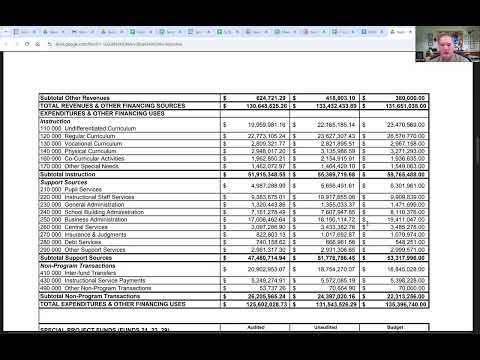
"The 2425 budget is not balanced and expenses exceed the revenue budget by about $3.7 million," Fry said, describing the draft the board reviewed at a July 22 public hearing and will consider at its Aug. 26 meeting.
Fry explained several factors behind the gap. He said state equalized aid has risen—moving from about $56.5 million to roughly $61.3 million—reducing the district ependence on property tax revenue in the accounting, while one-time federal pandemic funds have largely expired. "That money has gone away," Fry said of ESSER funds; federal revenue is projected to fall from roughly $5 million last year to about $2 million in the coming year because most ESSER funding ends Sept. 30.
The director gave top-line budget figures: total revenue is projected at about $131.76 million while total expenses are roughly $135.4 million. To cover the shortfall on paper, Fry said the district plans a drawdown of fund balance that would move reserves from about $33.5 million down to an estimated $29.8 million under the current draft.
Fry also highlighted rising special education costs. He said the district contributed approximately $15.2 million from local sources to special education last year and plans to increase that local contribution to about $16.8 million next year to cover growing costs.
Other budget details Fry reviewed included grant-restricted funds that must balance (he cited fund 27 with approximately $25.4 million of expenses matched to revenues), debt-service accounts used to pay bonds (funds 38 and 49), and long-term capital project funds (46 and 49). He noted fund 50—or capital projects declined by about $600,000 last year, and fund 80 for community services currently shows roughly $1.1 million in revenue versus $1.2 million in expenses, with a plan to draw down some of its balance.
Fry walked the board through the 65.90 reporting format the district must use to publish budget information and said the 65.90 form will go to the district esignated newspaper once the board approves the budget. He said that if the board approves the draft at its Aug. 26 meeting, the budget would be presented to the public at the Oct. 7 annual meeting and finalized by the end of October after any required adjustments.
The presentation summarized months of budget work that included enrollment projections from the University of Wisconsin, a January five-year forecast discussion, capital maintenance and improvement planning, and a July 22 public hearing where the board and public asked questions of staff. Fry invited questions and provided a contact for further information.
The board is scheduled to consider the proposed 2024–25 budget at its Aug. 26 meeting; no formal vote outcome is recorded in this presentation.