Get Full Government Meeting Transcripts, Videos, & Alerts Forever!
Get email alerts on the Community Responders topic
No spam. Unsubscribe anytime.
Urbana task force previews draft community-responder program, projects 3–4 teams and about 11 eligible calls per day
Summary
Task force presenters outlined a draft METCAD dispatch protocol, staffing scenarios (three- or four-team models), rough budget estimates (a three-team start-up projection shown), hiring guidance favoring lived experience and multilingual capacity, and next steps including a community meeting and preliminary recommendations.
Danielle, the meeting moderator, opened the Urbana task-force session and said the group would review a logic model and a draft dispatch protocol that would let METCAD screen and recommend a community-responder unit for eligible, nonviolent 911 calls.
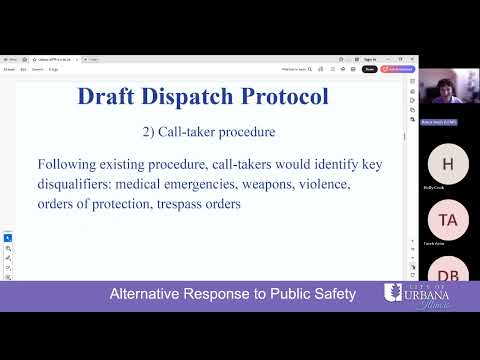
Presenters described a multi-stage screening flow: a 911 call-taker first screens for medical or violent disqualifiers; CAD programming would then recommend the community-responder program for qualifying calls; a dispatcher would check address-level flags (for example, responder-safety alerts or orders of protection) before dispatching. Amos, a presenter, described the software step and said the CAD recommendation “makes it very efficient” and that, used correctly, the approach “would not increase the time that it takes for the call taker and dispatcher to assign a unit to the call.”
The group reviewed hourly call-volume patterns and two staffing options. The presenters modeled a three-team approach (six responders, covering roughly two 7-hour shifts such as 10 a.m.–5 p.m. and 5 p.m.–midnight) and a four-team approach (eight responders, covering roughly 8 a.m.–1 a.m.). When asked to clarify the chart, the presenter said the vertical axis shows average eligible calls per hour and confirmed a daily average of about 11 eligible calls ("11.3" was cited during Q&A).
On safety and data sharing, presenters and staff acknowledged open implementation questions. Task-force members asked how often address-level safety alerts are updated, who can access law-enforcement records, and whether community responders would have the same information police do. Presenters said some alerts exist in CAD but that programs often rely on recent call history as an additional indicator, and they warned that checking prior records before dispatch could add modest time to the dispatch process.
Budget and timeline were presented as preliminary, ballpark figures. The team showed a preparation phase followed by operation (examples used: 9 months preparation and 12 months operation), noted most costs are personnel-driven once responders are hired, and gave a sample three-team annual operating projection in the low-mid hundreds of thousands (presenters stressed these are estimates and invited refinement). Presenters also emphasized procurement timing — vehicles and technology should be started early because acquisition can take months.
Task-force members pressed on staffing and hiring. Presenters reviewed lessons from other cities (Cincinnati, San Francisco, Antioch, Phoenix and others) where programs shifted clinicians into supervisory or follow-up roles and used trained civilians, EMTs, or peer specialists as frontline responders. Several members argued job descriptions should not exclude candidates with lived experience and recommended listing preferred credentials (LCSW, peer-support certification, EMT) without requiring them, both to widen the applicant pool and to preserve options for hiring licensed supervisors.
Members also raised equity and operations concerns: multilingual capacity (Spanish, French) should be prioritized or funded via translator partnerships; an RFP should score collaboration and cultural competency; and the program must be designed as a clear bridge to local services (housing, domestic-violence supports, immigrant services) rather than an isolated response unit. Multiple participants urged that metrics and contractual language require documented pathways to partners and to MedCad/police/fire where appropriate.
The task force did not take formal votes. Staff outlined next steps: draft preliminary recommendations for the task force’s review, host a community engagement meeting in the City Council chambers the following day (5:30–7:30 p.m.), and reconvene the task force on June 11, 2026. The presenters repeatedly characterized the materials as draft and asked for feedback and technical questions to refine eligibility, staffing and budget assumptions.
Ending: The meeting closed with an invitation to the community engagement session and a request that members submit comments on the preliminary recommendations when circulated.