Get Full Government Meeting Transcripts, Videos, & Alerts Forever!
Get email alerts on the Rent Stabilization topic
No spam. Unsubscribe anytime.
City staff explain Mountain View rent-stabilization rules, deposit caps and eviction protections
Summary
City of Mountain View staff held a May 12 webinar to review the voter-approved rent-stabilization measure, explaining which units are covered, AB12 limits on security deposits effective July 1, 2024, allowable annual rent increases and new anti-retaliation rules; staff also described petitions and local help-center hours.
City of Mountain View staff presented a bilingual webinar on May 12, 2026, summarizing the city’s rent-stabilization rules under the Community Stabilization measure and related state law changes.
The presentation, led by city staff and interpreted by Rosario Bermúdez, covered which rental units are fully or partially covered, limits on security deposits under AB12, the annual general adjustment (AGA) that governs permitted rent increases, utility-billing rules for covered units, eviction protections and the process for filing petitions and reports of retaliation or harassment.
Why this matters: the webinar consolidated several recent changes renters and landlords must know. Staff emphasized that many protections apply to older rental stock and that new state and local rules limit upfront tenant costs and narrow the grounds for eviction.
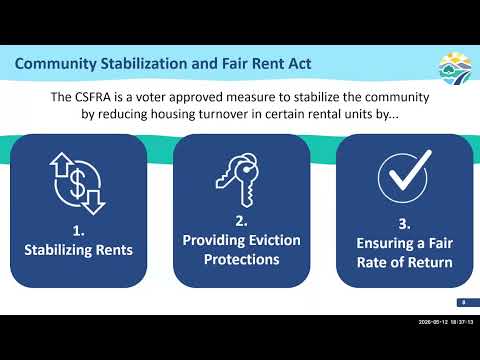
Staff said the Community Stabilization measure is intended to (1) stabilize rents, (2) provide eviction protections, and (3) ensure landlords a fair rate of return. City staff explained that units built before Dec. 23, 2016, are generally within the measure’s coverage window, with a distinction between "fully covered" units (rent stabilization plus eviction protections; typically pre-1995 and not government/subsidized) and "partially covered" units (eviction protections only, typically built 1995–2017 and not public/subsidized).
On security deposits, staff summarized AB12 (effective July 1, 2024) and said that for tenancies starting after that date a security deposit generally cannot exceed one month’s rent. An exception allows up to two months’ rent when the landlord is a natural person or an LLC that owns no more than two residential properties containing no more than four rental dwelling units.
Staff defined what counts as base rent (initial rent, parking fees, pet fees, storage, utilities and housing services when included in the rental agreement) and clarified that security deposits are not rent and cannot be raised during an active tenancy. At move-out, allowable deductions from a deposit include unpaid rent, property damage and cleaning costs.
On rent increases, the presenter said the Rental Housing Committee sets the annual general adjustment (AGA). The webinar showed historical AGAs and stated that the AGA for Sept. 1, 2026–Aug. 31, 2027, will be 2.5%; staff noted 2025’s AGA was shown as 2.7% on the materials. Only one permitted AGA increase may be applied in any 12-month period. The staff also explained "banked" (accumulated) increases: previously allowed but unused increases may be applied as a cumulative adjustment, up to a 10% total, subject to petition rules.
Utilities: under recent 2024 regulations staff said that for new tenancies beginning March 1, 2024, the total rent must include utilities for fully covered units and rental agreements must specify which utilities and housing-service fees are included. Tenants who pay utilities directly to providers (for example, PG&E or other metered arrangements) may be exempt. Existing tenancies may continue prior utility billing arrangements until a utility-adjustment petition is filed and approved under the city’s CSFA regulations (chapter 13).
Evictions and process: staff listed limited tenant-caused reasons (failure to pay rent, lease breaches, criminal activity, failure to provide access) and landlord-caused reasons that may qualify for termination (temporary vacancy for repairs, owner move-in, withdrawal from the rental market, demolition). Staff said some tenant causes require a prior "notice to cease" and some landlord causes trigger relocation assistance and a right of return for qualifying households. Staff outlined the eviction timeline: landlords must provide copies of termination notices and unlawful detainers to the Rental Housing Committee; tenants typically have 10 business days to respond or risk a default judgment; if tenants respond the case proceeds to court for adjudication.
Constructive evictions are prohibited, staff said, and they listed examples such as changing locks, cutting off utilities, harassment, preventing entry and unresolved habitability problems.
Petitions and remedies: staff explained landlord petitions for upward rent adjustments to secure a fair return, joint petitions for added housing services requested by tenants and additional occupants, and tenant petitions for downward adjustments when rent is unlawful or habitability has been compromised (for example, infestation or removal of previously available services such as a pool). An "undue hardship" petition was described as available to tenants who previously received banked increases exceeding that year’s AGA.
Anti-retaliation and anti-harassment: staff outlined newly adopted rules prohibiting retaliation or harassment tied to protected tenant activities (reporting unsafe conditions, filing petitions, organizing tenants, requesting reasonable accommodation or calling police in emergencies). Staff emphasized that filing a report is not an automatic enforcement finding by the city and that harassment claims may still be adjudicated in court.
Resources: staff encouraged tenants and landlords to use the city’s Rental Stabilization Division for one-on-one assistance, described recurring help-center hours (landlord help: Thursdays 1–3 p.m.; tenant help: first and third Thursdays 6–8 p.m.) and provided a contact phone number noted in the webinar materials (650-903-6136). Staff said they will email a recording and the slides after the session.
What the city did not decide today: the webinar was informational; no votes or formal actions were taken during the session. Staff advised attendees on how to file petitions and where to seek individualized help.
Speaker attribution: the presentation was given by city staff (presenter) and interpreted into Spanish by Rosario Bermúdez, who introduced herself during the webinar.
Next steps: staff will post the recording and slides and continue to accept petitions, reports and inquiries through the Rental Stabilization Division. The city’s Rental Housing Committee sets the AGA annually and petitions are reviewed under the CSFA regulations (chapter 13).