Get Full Government Meeting Transcripts, Videos, & Alerts Forever!
Get email alerts on the General Plan topic
No spam. Unsubscribe anytime.
San Bernardino planning staff preview 2050 General Plan, set EIR schedule; no votes held due to lack of quorum
Summary
At a May 12, 2026 study session, consultant Mark Hoffman presented highlights of San Bernardino’s 2050 General Plan update — including land-use consolidations, projected buildout, and a final EIR target of Sept. 26, 2026 — while commissioners postponed action on agenda items because there was no quorum.
At a May 12, 2026 study session of the San Bernardino Planning Commission, consultant Mark Hoffman presented the key components of the city’s 2050 General Plan update and outlined the associated environmental review schedule, while commissioners were unable to take votes because the meeting lacked a quorum.
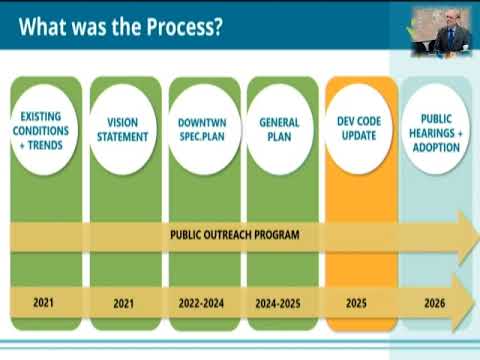
Hoffman, the principal in charge of the general plan project, said the update packages three related efforts — the general plan document itself, a development-code update and a downtown specific plan — and reflects more than five years of public outreach, including a community vision survey that yielded more than 1,500 comments. He said the administration’s implementation program includes roughly 225–250 programs intended to guide city actions through 2050.
Why it matters: the draft plan would consolidate many land-use categories, add three mixed‑use districts, raise allowable densities in targeted residential categories to respond to state housing law, and change circulation priorities to emphasize walking, biking and targeted truck routes. Hoffman said the plan’s high‑level buildout estimates for the planning area are roughly 36,000 new homes, about 64,000 additional residents and roughly 60,500–61,000 new jobs over the planning horizon.
Hoffman also reviewed the environmental review timeline. He said staff expects to post an updated public‑review package at the end of May (replacing the December 2025 posting) and that the final environmental impact report (EIR) is scheduled to be complete on Sept. 26, 2026, with public hearings to follow before the Planning Commission and City Council in fall 2026. “We’re preparing the final EIR. So we’re midway through the process,” Hoffman said.
On cost and funding, Hoffman said the multi‑document effort is in the roughly $4.5 million range, including an initial $3 million state stipend and other funds. He described outreach that included neighborhood workshops, advisory committee meetings and topic‑specific events.
Key policy shifts described in the presentation included:
- Land‑use consolidation: reducing roughly 25 prior general‑plan districts to 12 broader categories and adding three mixed‑use districts (neighborhood, corridor and center) designed to enable higher densities where mixed use can be financially feasible.
- Housing and densities: higher density ranges for medium and high residential categories to align with forthcoming housing obligations; a temporary highest‑density zoning category (up to 55 units per acre) would remain in place through about 2027.
- Mobility and truck routing: a stronger emphasis on pedestrian infrastructure, about 40 lane miles of new bicycle routes, updated transit policies and a refocusing of truck routes to industrial corridors primarily in the southern portion of San Bernardino rather than citywide truck access.
- Environmental justice, open space and safety: a standalone health and environmental justice element, expanded open‑space and habitat conservation policies, and a substantially updated safety element addressing wildfire and evacuation; staff reported CalFire had reviewed the safety element and asked for one additional policy strengthening vegetation‑clearance standards in foothill areas.
Commissioners asked technical and process questions about when the development code and downtown specific plan would be publicly available, whether the EIR’s completion amounts to state approval (Hoffman said the EIR is the environmental document and may attract third‑party comment but is not the same as the separate agency approvals that some elements (such as certain housing or safety elements) have required in other contexts), and how the city will manage existing permits during the transition to new standards. Hoffman said the downtown specific plan and the general‑plan/EIR package will be released together for public review; the development code is still being finalized and may not post at the exact same time.
Because the commission did not have a quorum at the start of the meeting, the body did not vote on agenda items 1–3 and staff indicated those items will be continued to a future meeting. The meeting proceeded as a study session to receive the general plan presentation and to allow commissioners to ask clarifying questions.
What’s next: staff expects to post the public‑review draft and the accompanying environmental document at the end of May 2026, circulate the final EIR in late September 2026, and schedule public hearings before the Planning Commission and City Council in fall 2026. No formal approvals or changes to the plan were adopted at the May 12 study session because of the lack of quorum.
Sources: presentation and Q&A at the May 12, 2026 San Bernardino Planning Commission study session; consultant Mark Hoffman (principal in charge, general plan project).